
The government has moved to clarify what it says is a major threat to the integrity of Guyana’s tax system, welcoming a recent court ruling that reinforces the Guyana Revenue Authority’s (GRA) power to conduct post-clearance assessments.
According to the President, a previous ruling by Justice Gino Persaud had created serious concerns within the legal and professional community, with many describing it as a decision that could “incentivize the falsification of documents” and expose the country’s taxation framework to “criminality and fraud.”
He explained that post-clearance verification is a long-standing feature of customs administration, allowing the GRA to reassess the value of goods and apply the correct taxes even after items have left the port.
“There is something in post-clearance that inherently deals with the verification of values and the ability of the Revenue Authority after verification to apply the right taxes,” he noted.
The government, he said, is therefore “pleased” with the landmark ruling delivered on November 17, 2025, by Chief Justice Roxanne George in the matter of Zhang Zhenyu v. Guyana Revenue Authority. He described the judgment as “compelling, meticulously reasoned, intellectually rigorous, and formally rooted,” adding that it upholds both the rule of law and the practical necessities of modern customs operations.
Justice George’s decision, he said, brings “clarity to an area of significant public importance” by reaffirming that the GRA has the authority to conduct post-clearance assessments of imported consignments. Her ruling, he added, “demonstrates a deep understanding of the customs framework, the evolution of trade facilitation practices, and the responsibilities of a revenue authority charged with safeguarding the state’s fiscal interests.”
The President reminded that post-clearance audits are neither new nor unique to Guyana. They have existed for decades, previously carried out by the inspections department of the former Customs and Excise Department.
As international trade modernized and customs processes worldwide became more streamlined, post-clearance controls became even more essential. He noted that the World Customs Organization endorses such systems, and Justice George has now “authoritatively affirmed” their legality in Guyana.
In sharp contrast, he said the earlier ruling by Justice Persaud has “confounded many observers” and is regarded by the GRA as “fundamentally flawed in law.” That decision, now under appeal, was widely criticized as “perverse, internally inconsistent, and disconnected from both established custom practice and the evident intention of the Customs Act.”
The President said many Guyanese remain “baffled” by how such a conclusion was reached, especially since the case before the court involved allegations that an imported luxury motor vehicle had been declared with falsified documentation.
He warned that allowing Justice Persaud’s ruling to stand would be “profoundly damaging,” essentially preventing the GRA from recovering taxes owed to the state once goods had passed through the port, “regardless of how falsified, regardless of the level of falsification, regardless of what falsification is discovered thereafter.”
“It would render the customs administration toothless, incentivize dishonest declarations, and deprive the state of significant revenue,” he said, calling such an outcome “wholly inconceivable in a lawful and orderly revenue system.”
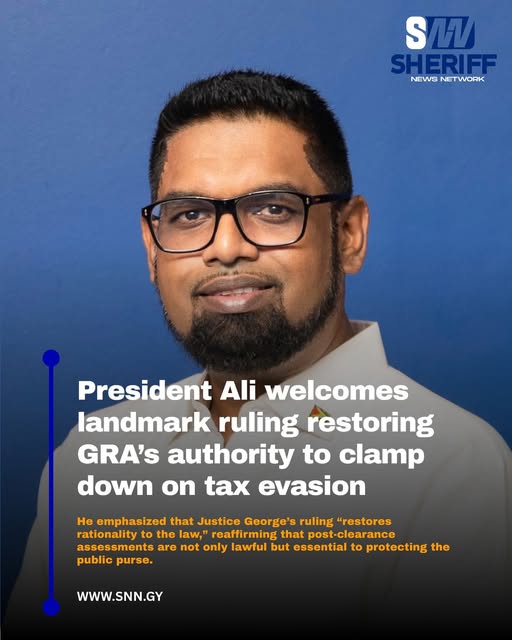
He emphasized that Justice George’s ruling “restores rationality to the law,” reaffirming that post-clearance assessments are not only lawful but essential to protecting the public purse. The government, he said, welcomes the judgment for “reestablishing coherence in customs jurisprudence” and ensuring that the GRA can continue carrying out its mandate without “artificial or ill-conceived constraints.”
“The post-clearance mechanism is a mechanism for the ease of trade, the ease of doing business. But it comes with a system of verification,” he added, stressing that in the present case, “the evidence is glaring and clear that documents” were not what they were declared to be.
The administration maintains that safeguarding the integrity of customs operations is critical to protecting state revenue and preventing loopholes that could enable fraud.