
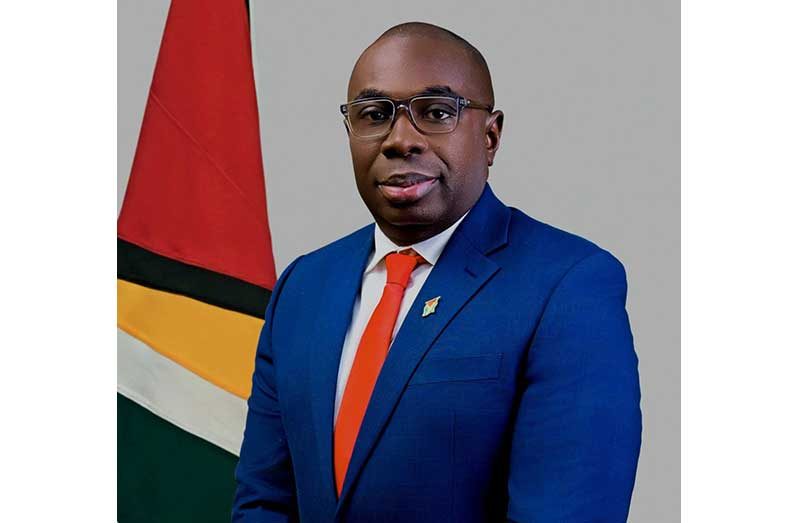

Minister within the Office of the Prime Minister, Kwame McCoy, has taken issue with sections of the European Union’s final report on the 2025 General and Regional Elections, arguing that while the document praises the electoral process, it also creates an unfair narrative about the role of the sitting government during an election year.
McCoy noted that the report acknowledges the professionalism of polling staff, the peaceful atmosphere, the reforms implemented since 2022 and the overall competence displayed throughout the process. However, he said it then shifts into what he described as a familiar argument, that the incumbent administration holds an inherent advantage, almost as though effective governance becomes a form of misconduct whenever an election approaches.
He pointed out that, according to the report’s reasoning, a government would need to pull back from normal duties simply to avoid the appearance of competitiveness. He said this would mean officials avoiding community visits, pausing already-budgeted projects, and limiting routine state work because such activities could be seen as advantages. Even ribbon-cutting ceremonies, hospital openings and support for farmers were framed as risky territory. McCoy argued that this would amount to forcing an administration to become “invisible,” which he emphasised is not how democracies operate.
The minister compared the EU’s stance to practices within European democracies themselves, where governments actively campaign on their achievements, launch programmes and take credit for their work. He said those governments do not halt development to appease political opponents, as their performance is judged by the public, not by how quiet they become during an election season. Yet, he added, in Guyana, doing the job too well is treated as something inherently suspicious.
McCoy also highlighted what he called a double standard, noting that many of the actions flagged in the report are typical of any political party. Opposition parties, he said, likewise visit communities, run programmes and work to win support, and in this election, the WIN party even resorted to vote-buying. Meanwhile, he pointed out, several media outlets openly boosted the opposition’s messaging with little scrutiny. He argued that it is only the government’s actions that seem to attract suspicion, which he described as absurd and unfair.
At the same time, McCoy acknowledged that the EU’s call for clearer rules on the use of state resources and campaign conduct is a reasonable recommendation, since transparency strengthens democratic systems. His concern, he explained, lies in the implication that normal governance activity during an election period is problematic by default, an interpretation he said risks undermining the very institutions the observers praise.
He stressed that Guyana should not adopt any model that weakens executive functions every five years. Schools, roads, hospitals and social support systems, he said, are not perks of incumbency but essential services, and treating them as political advantages blurs the line between proper governance and wrongdoing.
McCoy underscored that Guyana values its partnership with the EU, and its recommendations must be taken seriously. However, he added that some carry unintended consequences. If democracy depends on progress, he said, then progress must not become a liability during campaign season.
He concluded with a pointed reflection on the logic of such arguments, suggesting that if performing one’s duties during an election is now seen as a scandal, then perhaps the only safe form of governance would be to shut everything down until ballots are counted. He said such an approach would serve no one, not the government, not the opposition, and certainly not the voters who rely on uninterrupted development.