
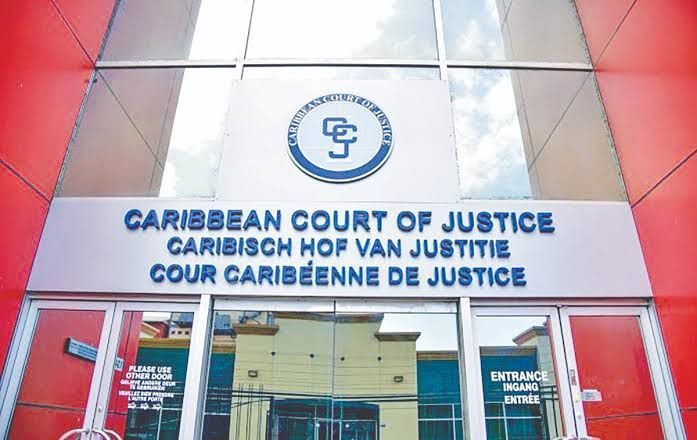

The Caribbean Court of Justice (CCJ) on Tuesday brought to a close a long-awaited hearing in a dispute that has lingered for a quarter of a century.
The case, filed in 2000 by Cara Investments Limited, challenges the conduct of Chartered Accountant and attorney-at-law Christopher Ram and the Bank of Nova Scotia in connection with efforts to sell the former Hotel Tower in Georgetown.
After hearing arguments from all sides, the CCJ announced that it will deliver its judgment at a later date.
The controversy dates back to the late 1990s, when the once-prominent hotel faced severe financial difficulties.
In an effort to recover its debts, the Bank of Nova Scotia appointed Ram as Receiver/Manager. Once installed, Ram took charge of the hotel’s assets and launched a public Request for Proposals (RFP) inviting purchase offers.
The RFP documents clearly stated that the Receiver retained sweeping discretion over the process, including the right to discontinue the exercise before any contract was finalised.
Cara Investments expressed interest near the end of 1999 and later obtained additional time to file a complete proposal.
However, just as the process seemed poised to advance, the company turned to the courts, arguing that the tender exercise was being mishandled.
Its lawsuit called for declarations of unfair treatment and breach of duty and also sought a court order preventing Ram from completing any sale until judicial scrutiny was applied.
In 2001, Cara succeeded in adding the bank as a co-defendant. Around this time, Ram—through counsel—undertook not to take any further steps in the tender process while the lawsuit remained active.
Consequently, no sale was completed under his receivership, and Ram’s role concluded in 2003 when the hotel’s shareholders independently sold their shares to a third-party investor.
When the matter eventually reached then Acting Chief Justice Ian Chang, the court examined the nature of Ram’s authority.
Justice Chang ruled that Ram functioned solely as the bank’s agent, meaning he could not personally be held liable for decisions made on the bank’s behalf.
The court further determined that the evidence failed to support claims of unfairness or improper conduct, especially given that the tender documents granted the Receiver wide autonomy.
Cara’s action was dismissed, and the company was ordered to pay costs. The Court of Appeal later upheld that decision.
Before the CCJ, attorney Sanjeev Datadin, representing Cara Investments, argued that even with broad discretionary powers, the Receiver remained obligated to act fairly.
He said the authority to cancel the RFP did not permit silence or inaction, insisting that bidders were entitled to be informed of the status of their proposals.
Datadin maintained that Ram neither cancelled the tender nor communicated any outcome to Cara, despite admitting he halted the process after giving an undertaking to the court.
Justice Peter Jamadar questioned this line of argument, noting Cara’s acknowledgment that the RFP explicitly allowed the Receiver to cancel the exercise entirely.
Presenting Ram’s response, Senior Counsel Neil Boston said no contractual breach was possible because the RFP did not create binding obligations.
He pointed out that Cara’s bid of US$2 million fell short of the hotel’s debts, which exceeded US$2.5 million, making success improbable.
Bank attorney Kamal Ramkarran similarly argued that no contract existed and that no communication could be required for a process that was never formally concluded.
Cara Investments is urging the CCJ to reverse the previous rulings and award significant damages.
The matter was heard by CCJ President Justice Winston Anderson and Justices Maureen Rajnauth-Lee, Chantal Ononaiwu, Peter Jamadar, and Chile Eboe-Osuji.