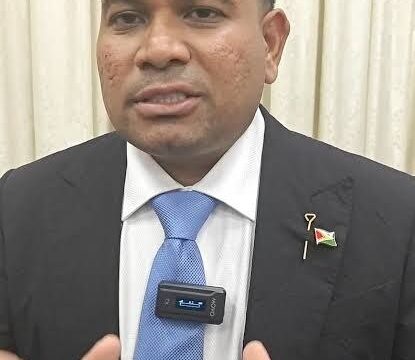


Attorney General Anil Nandlall, SC, on Monday made it clear that once a committal order is issued in the extradition proceedings involving Azruddin and Nazar Mohamed, the law requires that they be taken into custody.
“That is what the law provides for. That once the committal order is made, they are to be taken in the custody,” Nandlall told reporters following the High Court’s refusal to stay the proceedings in the Magistrate’s Court.
Reacting to the ruling by Acting Chief Justice Navindra Singh, the Attorney General said the decision was consistent with settled legal principles governing extradition matters.
“The decision of the Lord and Chief Justice is in alignment with the policy of the law, the provisions of the law, and the existing judicial authorities in Guyana, across the Caribbean, North America, and Commonwealth on this matter,” he said.
Nandlall explained that the application before the court was an interlocutory one, which he described as attempts to delay or protract the committal hearing.
“I drew attention to a series of cases from Guyana, from the Caribbean, from North America, and from other parts of the Commonwealth… to show the judge the approach that has been taken in extradition matters in relation to matters of this nature,” he said, adding that courts have “universally and uniformly rejected any type of intervention that seeks to stay, stop, or delay the committal hearing from taking place.”
According to the Attorney General, the law provides a structured process for challenges, but only after the committal proceedings are concluded.
“The reason why is because post the committal hearing, there is an elaborate regime of challenges that the law provides for any party who is aggrieved by the committal hearing’s ruling, either side,” he said. “In that regime of procedure, there is a built-in mechanism that stays the extradition process while those challenges are being exercised.”
He stressed that the intent of the law is not to interfere with the Magistrate’s Court proceedings.
“Clearly, the scheme of the law, the intent of the law is to allow the extradition process to be fluid… not to interfere or stultify the committal proceedings,” Nandlall said, noting that the remedies “all exist and lie ex post facto the committal proceedings.”
The Attorney General also disclosed that the High Court has signalled its intention to hear the substantive constitutional challenges on the 14th of this month.
“The court has signaled an intent to, on the 14th of this month, to hear the substantive matter,” he said, adding that another application filed by the Mohameds, challenging the government’s authority to extradite them on the grounds of alleged political bias, will also be heard on that date.
Describing the legal strategy being employed by the defence, Nandlall said, “The truth of the matter is that these, as I said before, are all proceedings intended to delay.”
He argued that similar challenges would be filed again if a committal order is made.
“That is why I am saying the prior challenges are an abuse of process,” he said. “But substantially, they are going to be the same.”
Addressing questions about whether extradition would be automatic following a ruling in the Magistrate’s Court, the Attorney General was emphatic that it would not.
“No, it’s not automatic,” he said. “The committal proceedings would have been completed and then the Act now sets out a series of processes that must take place in execution of the extradition process.”
However, he reiterated that custody following a committal order is mandatory under the law, even as further legal steps and challenges remain available to both sides.