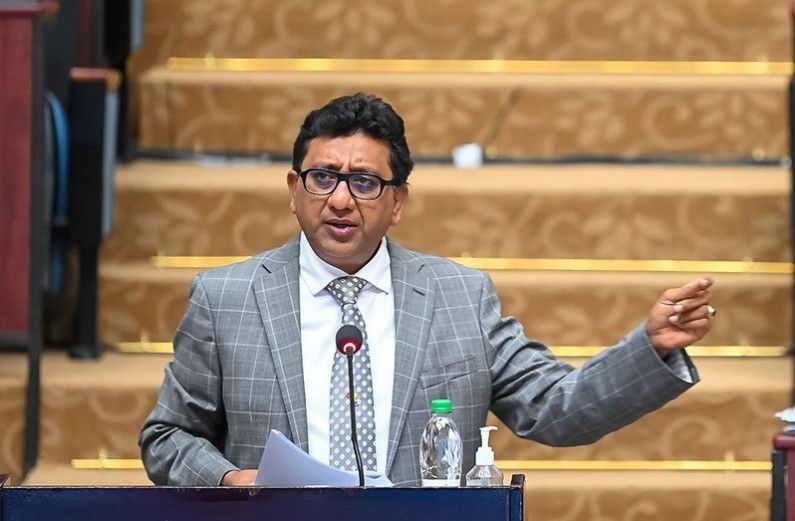

Attorney General and Minister of Legal Affairs Anil Nandlall, SC, on Tuesday night pushed back strongly against opposition figures criticising Budget 2026, arguing that the spending plan reflects the governing People’s Progressive Party/Civic’s election promises and the mandate it says it received from voters.
“This is our budget. This is what we promised the people, and this is what they voted for,” Nandlall said, contending that opposition parties’ plans were rejected at the polls and that their criticism is rooted in the fact that the budget does not mirror their own proposals.
Nandlall’s remarks came one day after Finance Minister Dr. Ashni Singh presented the national budget in the National Assembly on Monday, January 26, 2026, under the theme “Putting People First.”
He said the government considers it a “sacred” responsibility to implement the programme it campaigned on, while dismissing opposition attacks as politically predictable.
“The opposition, as I said, will oppose; it’s not their budget,” he said, adding: “We consider it our sacred duty to deliver the promises in that manifesto, and that is what we are doing.”
Nandlall pointed to headline allocations he said demonstrate the budget’s focus on citizens, listing $196.1 billion for roads and bridges, $183.6 billion for education, $161.1 billion for health, $151.1 billion for housing, $119.4 billion for energy expansion and diversification, $113.2 billion for agriculture, $100 billion for the security sector, and $78.3 billion for social services.
He argued that the beneficiaries cut across all communities and political affiliations, repeatedly returning to the theme that the projects are meant to serve the wider population.
“Who are going to benefit from these allocations?” he asked. “People. The common thread here is people. And that’s why the budget has the theme, putting people first.”
Addressing criticism that the government is spending too heavily on infrastructure, the Attorney General said Guyana is still catching up after decades of underdevelopment and must build out modern roads, bridges and other national assets.
“We promised them proper infrastructure… we have to build out the country,” he said. “You want to continue walking in mud?”
In a sweeping defence of the capital programme, Nandlall cited major highway expansions and river crossings, including the Demerara crossing, East Coast–East Bank connections, interior road links, and proposals for additional bridges and crossings in multiple regions. He argued that new roadways open lands, stimulate investment, raise property values, and save travel time that can be redirected into productive activity.
He also acknowledged that delays can occur on large projects due to common constraints such as weather, labour, and material availability, but maintained that the overall direction is to transform the country.
Nandlall also framed Budget 2026 within what he described as Guyana’s rapid economic expansion, saying the economy has grown in “double digit figures” and projecting continued growth in 2026, claims he attributed to “prudent management” and “sound macroeconomic planning.”
He said major energy investments, including gas-to-energy and solar initiatives, are aimed at reducing electricity costs and ending blackouts, which he argued have long constrained manufacturing and value-added production.
“Within the next two years… blackout will be history in Guyana,” he said, linking cheaper, more reliable power to future competitiveness in manufacturing and agro-processing.
Beyond capital works, Nandlall highlighted a slate of measures he said will increase disposable income and reduce household burdens, including tax and VAT changes, targeted grants, and new financing options for small businesses and homeowners.
Among the measures he outlined were incentives for investment in designated development zones; removal of corporate taxes for the agri-industry and agro-processing; VAT removal on locally made furniture and jewellery; changes to the Marriage Act to remove a 15-day in-country requirement for marriage licences as part of promoting destination weddings; and the removal of VAT and duty on security equipment.
On housing, he pointed to the continuation and expansion of subsidies and construction support, including $7.5 billion allocated for housing subsidies and continuation of the cement and steel programme, alongside changes to low-income lending ceilings.
Nandlall also outlined adjustments to vehicle-related taxes and duties, particularly for small-engine vehicles, hybrids and ATVs used in hinterland communities, and the continuation of policies he said cushion fuel prices and freight costs.
He further noted increases to education and social support measures, including the Because We Care cash grant rising to $60,000, a $20,000 school transportation grant, and a uniform voucher, alongside an increase in old-age pension to $46,000 per month and a one-off $20,000 pensioner transportation grant. He also referenced increases to public assistance and commitments to additional cash grants and threshold changes aimed at reducing income tax burdens.
To this end, the Attorney General argued that the combined weight of infrastructure spending and household-focused measures undermines claims that Budget 2026 is out of touch with citizens’ needs.
“How can you, with a clear conscience, say that this budget does not provide for people?” he asked, insisting the government is delivering “the first instalment” of the programme it presented to the electorate.