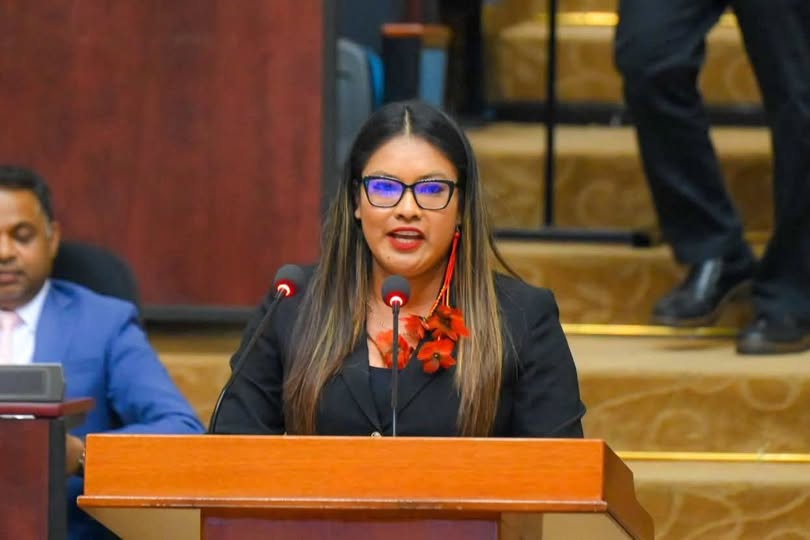

Minister of Amerindian Affairs, Sarah Browne-Shadeek, on Tuesday pushed back against comments made in Parliament suggesting that Amerindians should no longer be living in traditional troolie houses, saying such views are offensive and reflect a misunderstanding of Indigenous culture and development.
Addressing the National Assembly during the Budget 2026 debates, Browne-Shadeek said she was compelled to respond after receiving a WhatsApp message at 1:55 a.m. from a young Patamona woman from Kato, Region Eight.
The minister told the House that the message included a screenshot of a media report quoting an opposition MP as saying, “I strongly believe, Mister Speaker, that the days for Amerindians to be living in troolie houses should now be over with. All the wealth that this country has. You can’t born, grow and dead in a troolie house. We want mansions too, like some of the honorable members on the other side.”
Browne-Shadeek then read the response she received from Luana Augustus of Kato.
“Good night minister, this is very offensive. I hope you will debunk this nonsense peddled by the opposition. Traditional homes are not symbols of failure or poverty. They reflect culture, climate, knowledge, sustainability and identity passed down for generations,” Augustus said.
According to the minister, the message went on to stress that development should expand choices, not erase culture.
“Development should give people choices, not erase who we are. And what’s sad is when some of our own indigenous brothers and sisters repeat this narrative, looking down on our traditional living,” Augustus stated.
Browne-Shadeek added that the young woman outlined what she described as real progress, including “clean water, free health care, free education, roads and opportunities to improve our livelihoods,” noting that this is what the government is committed to delivering.
The minister told the House that Augustus also emphasised that development should never come at the cost of erasing culture.
“Not everyone wants the same definition of development,” Browne-Shadeek quoted.
She further pointed out that while improving housing conditions for vulnerable families remains important, government programmes in parts of Region Eight showed that when residents were consulted, many opted for traditional housing styles.
“That choice is important. Our people have lived in troolie and traditional houses for generations,” the minister said.
Browne-Shadeek cautioned against generalising Indigenous living arrangements, arguing that suggesting traditional homes need replacing amounts to speaking down to Amerindian communities.
“To generalize and imply that our way of life needs replacing is to speak down on indigenous people,” she said, adding, “Real development is about options, dignity and consultation.”