
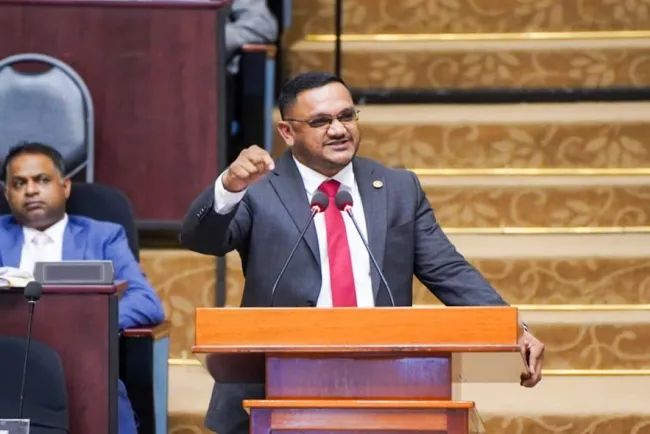

Minister of Natural Resources Vickram Bharrat on Tuesday told the National Assembly of Guyana that Guyana’s oil and gas sector is now regarded internationally as one of the best managed among producing countries, pointing to transparency, accountability and visible development outcomes as proof.
“…let me say in this house, Mister Speaker, that Guyana’s oil and gas sector- and as patriots, we should be proud of this- Guyana’s oil and gas sector is regarded as one of the best managed oil and gas sector in the world,” Bharrat said during his contribution to the debate. “Every single new oil producing country is looking at Guyana as an example when they’re drafting their framework to manage the oil and gas sector.”
The minister said Guyana is currently assisting several emerging producers with drafting local content legislation and putting systems in place to manage their sectors efficiently.
Bharrat argued that the true test of management is whether citizens can see benefits on the ground. “An indicator as to how well or whether an oil and gas sector is managed properly, you can look around in your country, and you can be able, for yourself, to judge whether the benefits are flowing to our people,” he said, adding that Guyana’s ongoing development points to effective management.
Turning to oversight of oil revenues, the minister reminded the House that WIN MP Terrence Campbell previously served on the Natural Resource Fund (NRF) Board. “He very well knows of the strict transparency and accountability measures that are in place to monitor oil funds,” Bharrat said.
He also recalled that the new Natural Resource Fund legislation was passed just one year after the PPP/C returned to office in December 2020. “One year after taking government… in this house we passed the new Natural Resource Fund bill,” Bharrat said, noting that many oil-producing countries took a decade or more to establish a sovereign wealth fund.
“Many of times we like to look at Norway as a model oil and gas country. Norway took over 20 years to put a sovereign wealth fund in place. We did so… after one year in government,” he said.
Bharrat stressed that the law prevents unilateral control over withdrawals from the fund. “Ensuring that the finance minister is not the one who dictates how funds should flow out of that natural resources fund, but the only way funds can flow… is that there must be approval from the National Assembly, all of us here,” he said.
He added that accountability provisions are strict, warning that failure to declare revenues could carry serious penalties. “The finance minister… can be jailed for 10 years if he doesn’t come to the parliament and declare the revenue that flows into the natural resources fund. Ten years and hard labor,” Bharrat said.
According to the minister, the NRF framework also requires clear disclosure in every national budget. “There is a prescribed formula that in every budget we can announce how much is in the Natural Resources fund, how much will flow into the budget, how much will remain at the ending of December 2026,” he said, noting that these figures were already presented by the Minister of Finance.
Bharrat said public access to information further reinforces trust. “Any individual, Guyanese or not, could go online, and you can look at the Gazette where we gazette the oil revenue that flows into the natural resource fund… That is transparency, that is accountability. That is how you manage an oil and gas sector.”