
Guyana has been identified as one of the countries the world is increasingly looking to for additional oil supply, as shifting global dynamics push prices higher and force a search for alternatives outside traditional markets.
This is according to an April 20, 2026 analysis by Rystad Energy, which found that South America is emerging as a critical source of new oil production, with Guyana playing a central role alongside Brazil and Suriname.
The report comes amid rising geopolitical tensions affecting supply routes, particularly around the Strait of Hormuz, which has triggered a sharp upward revision in oil price forecasts. Rystad’s Senior Vice President for Oil and Gas Research, Radhika Bansal, said the shift has placed the region in a strategic position globally.
“The Middle East conflict has done more than spike oil prices – it has exposed how dangerously concentrated global supply chains are around the Strait of Hormuz. South America is now positioned as the world’s most consequential source of incremental supply. The region offers scale, geologic quality and relative political stability at exactly the moment that the world is shopping for alternatives,” she said.
According to the report, offshore developments in Guyana are among the most immediate opportunities to increase global oil supply.
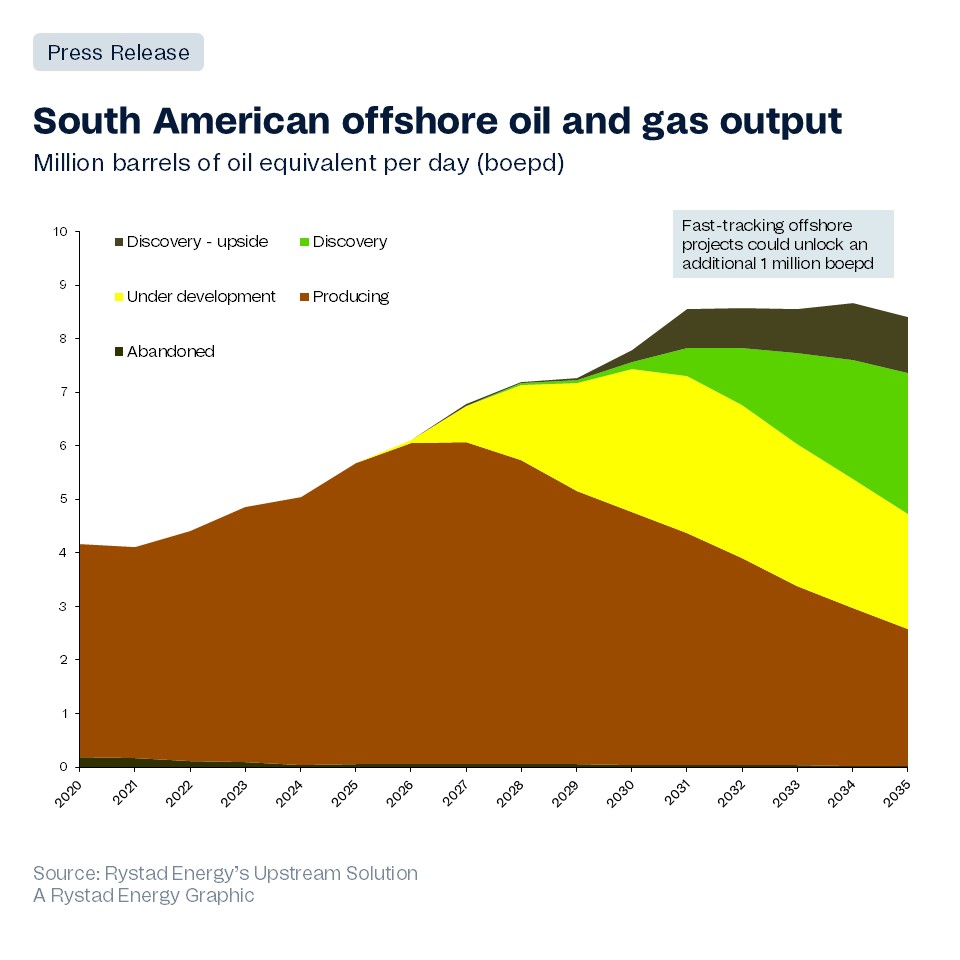
“Offshore developments in Brazil, Guyana and Suriname represent the most immediate source of upside,” the analysis stated, noting that fast-tracking projects across these markets could deliver more than one million barrels of oil equivalent per day over the next decade.
In Guyana’s case, ExxonMobil is targeting production of up to 300,000 barrels per day (bpd) from its Yellowtail development, which has already started producing at an average of 250,000 bpd. Rystad further noted that additional gains could come from optimising existing operations, estimating that similar debottlenecking efforts could unlock between 80,000 and 90,000 bpd across projects such as Errea Wittu, Jaguar and Hammerhead. However, the report made it clear that the biggest production gains will come from new developments rather than expanding existing ones, pointing to earlier final investment decisions (FIDs) as critical to unlocking further growth.
While Guyana and its regional counterparts hold significant untapped potential, Rystad warned that capturing that upside will depend heavily on execution and investment conditions.
“The pace of growth across South America will depend less on resource availability or economics and more on execution capacity, supply-chain constraints and the broader investment environment,” Bansal explained.
“Countries that provide clear fiscal and regulatory frameworks are better positioned to accelerate project sanctions and capture the upside from higher prices. Those that hesitate or are slow to move will simply watch the capital flow elsewhere.”
The report also highlighted that limited global capacity to build floating production, storage and offloading (FPSO) vessels could slow the pace of expansion, even as demand for new projects grows. Rystad’s analysis projects that higher oil prices could significantly boost government revenues across South America, reinforcing the sector’s importance to national economies. At current production levels, the firm estimates that governments in the region could see an additional US$43 billion in revenues this year alone compared to earlier forecasts.