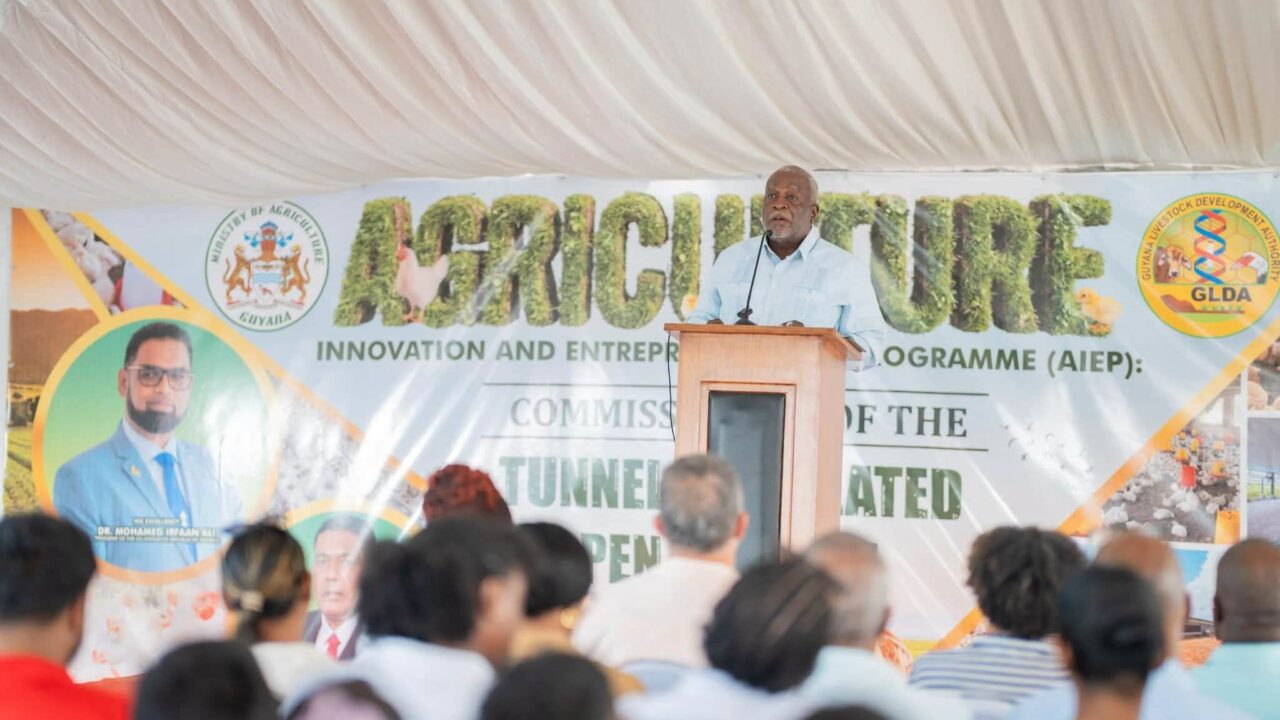

Prime Minister Brigadier (Ret’d) Mark Phillips says the commissioning of the Tunnel Ventilated Pens Project marks another significant milestone in the Government’s efforts to modernise agriculture, strengthen food security, and build a resilient, technology-driven farming sector.
Speaking at the commissioning ceremony, the Prime Minister said the initiative reflects Guyana’s commitment to transforming the agricultural industry through science, innovation and modern production systems.
“This initiative is a declaration of intent. It signals that the days of subsistence farming and fragile harvests are giving way to a new era of resilience, abundance and technologically driven agriculture.”
He explained that the project demonstrates the new direction of Guyana’s agricultural sector, where technology is being used to protect farmers from climate-related and economic risks while improving productivity.
According to Prime Minister Phillips, tunnel-ventilated facilities, which are alreadyñ operating in several regions, will enable farmers to increase production, improve animal welfare, strengthen biosecurity and reduce operational risks.
“The introduction of tunnel houses in poultry will help reduce mortality rates from 10 per cent and above to 2.8 per cent, improving biosecurity and animal comfort.”
The Prime Minister said the initiative is designed not only to increase agricultural output but also to make the sector more competitive, sustainable and commercially attractive.
“The Tunnel Ventilated Pens Project reflects this Government’s commitment to building an inclusive agricultural economy where the next generation of farmers can participate in modern agribusiness ventures supported by technology, training and investment.”
He noted that the Government’s agricultural policies address challenges such as flooding, drought, pests, diseases, rising input costs, market volatility and post-harvest losses by promoting technology, locally produced inputs and value-added processing.
Prime Minister Phillips stressed that the Tunnel Ventilated Pens Project forms part of a broader strategy to modernise agriculture through continued investments in drainage and irrigation, farm-to-market roads, agro-processing facilities, cold storage infrastructure and domestic production of key agricultural inputs.
“This is transformation with a purpose. This is transformation that puts our farmers first. And this, my fellow Guyanese, is the future we are building together — a future where our farmers can sleep soundly, knowing that their Government stands with them every step of the way.”
He said Guyana is working to strengthen its position as the Caribbean’s food-producing capital by expanding arable land, increasing rice production, achieving self-sufficiency in crops such as corn and soya bean, modernising the sugar industry, and expanding livestock, fisheries and aquaculture.
The Prime Minister also highlighted the planned regional food hub at Yarrowkabra, port facilities at Charity, Parika and Port Kaituma, and the Gas-to-Energy Project as key investments expected to reduce production costs, improve market access and create new export opportunities.
He further noted that the Government is advancing agricultural innovation through improved rice varieties, drones for field monitoring, nano fertilisers, hydroponics, shade houses, drip irrigation, tissue culture technology, digital soil mapping and modern livestock breeding techniques.
According to the Government, rice production has increased from 559,789 tonnes in 2021 to more than 810,299 tonnes, while poultry production has grown from 43,736 tonnes in 2020 to 91,382 tonnes in 2025 and is projected to reach 99,310 tonnes in 2026.
The Government is also partnering with the private sector to expand corn and soya bean production, reduce livestock feed costs, improve breeding programmes and increase production across the livestock sector.
By 2030, the Government aims for at least 50 per cent of newly established agribusiness enterprises to be led by women and young people, in line with its broader diversification targets.
Concluding his address, Prime Minister Phillips said Guyana’s agricultural transformation is already producing tangible results.
“The agricultural revolution taking place in Guyana is real, transformative and full of promise. From modern livestock facilities and precision agriculture to expanded value chains and new opportunities for youth and women, we are witnessing the emergence of a new agricultural landscape.”