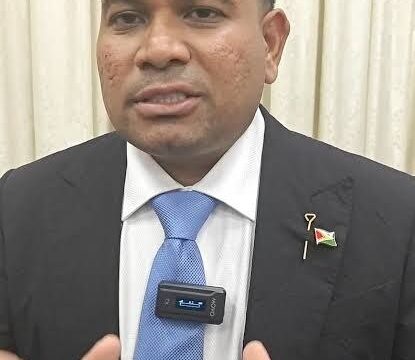
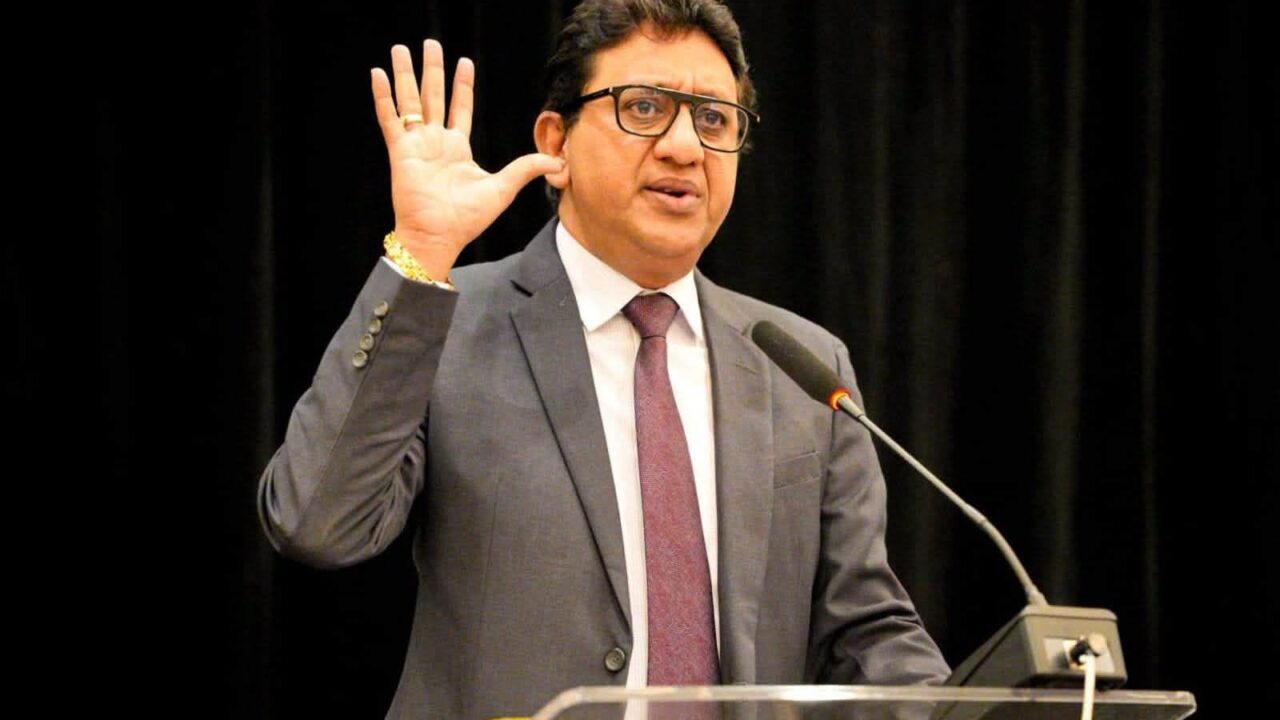

Attorney General and Minister of Legal Affairs Anil Nandlall has dismissed claims that Guyana is a dictatorship, arguing that such assertions are based on a misunderstanding of the country’s constitutional system and the principle of separation of powers.
Speaking during his Issues in the News programme, Nandlall said misinformation is often spread by people with academic credentials who speak confidently on issues they do not fully understand.
“And this misinformation sometimes come from lettered people, educated people, people with doctorates, people with the title professor preceding their names,” he said, adding that “the volume of ignorance that is spewed is alarming.”
The Attorney General took issue with claims that Guyana lacks separation of powers because government ministers also sit in Parliament.
According to Nandlall, Guyana inherited the Westminster constitutional model from Britain at Independence, a system shared by more than 50 former British territories, including Canada, Australia, New Zealand, Trinidad and Tobago and several African and Caribbean nations.
“And in all the countries, the members of the government are also members of the parliament in the respective countries,” he explained.
He noted that the doctrine of separation of powers was never intended to create a complete division between the executive, legislature and judiciary.
“When they speak about separation of powers, it was never intended for it to be pure separation. Because that doesn’t exist. Not even in the United States of America,” he said.
Nandlall argued that Guyana’s constitutional framework contains independent bodies, including the service commissions, which operate separately from the Executive and perform important constitutional functions.
To counter claims that Guyana is undemocratic, the Attorney General compared Guyana’s electoral system with Barbados’.
He pointed out that under Barbados’ first-past-the-post system, Prime Minister Mia Mottley’s Barbados Labour Party won all 30 parliamentary seats in the 2018, 2022 and 2026 general elections despite opposition parties receiving between 21 and 27 per cent of the popular vote.
“In Guyana, that is not possible. You cannot get one-fifth of the vote in Guyana under our PR system and don’t get about four or five seats,” he said.
Nandlall maintained that Guyana’s proportional representation system ensures smaller parties gain parliamentary representation, citing Amanza Desir as an example.
“Amanza Desir got a couple thousand votes, 3,000 something votes. And he’s in the parliament with a seat,” he said.
He argued that Guyana’s electoral model gives greater value to every vote than systems used elsewhere in the Commonwealth.
“So that I can give you practical examples of how superior our system of democracy is,” Nandlall stated.
The Attorney General also rejected suggestions that temporary breaks in parliamentary sittings indicate authoritarian rule, noting that Barbados has functioned for years without a parliamentary opposition because of election results.
“The Barbados Parliament has not had an opposition… I’m not saying that the BLP did anything wrong. I’m saying that this is what the system has produced. That’s what the people voted for. That’s the system that they embraced as their system of democracy,” he said.