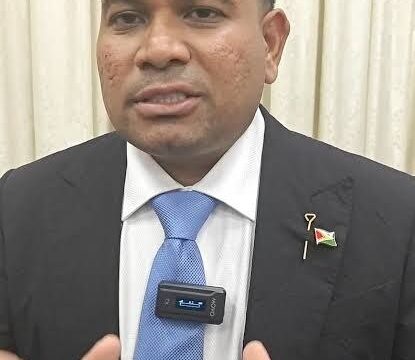


The Bar Council of the Bar Association of Guyana has condemned the leak of internal correspondence among judges of the Caribbean Court of Justice (CCJ), warning that the unauthorised disclosure of confidential judicial communications risks undermining the administration of justice and the integrity of the region’s highest court.
In a statement issued on Monday, the Bar Council said it had noted “with grave concern” media reports concerning the publication of internal correspondence among the judges of the CCJ.
The statement follows a Sunday Express report in Trinidad and Tobago that published what it said were internal emails in which several judges raised concerns about the leadership of CCJ President Justice Winston Anderson.
Without addressing the allegations contained in the correspondence, the Bar Council stressed that the CCJ, as Guyana’s final appellate court and the only court empowered to interpret and apply the Revised Treaty of Chaguaramas, “must remain a bastion of justice in the Caribbean.”
“Its institutional integrity must therefore be respected, protected and preserved,” the Council stated.
The Bar Council said the confidentiality of internal judicial communications is fundamental to the proper functioning of the Court.
“Internal correspondence and deliberations within the Court are, and must remain, confidential. By itself, the act of disclosing such correspondence—not its content—risks bringing the administration of justice into disrepute,” it said.
According to the Council, judges must be free to engage in frank and robust discussions without concern that their private deliberations will be exposed publicly.
“The legal profession expects and respects robust discussion among the members of the Court,” the statement continued.
It added that any unauthorised disclosure of confidential judicial correspondence would amount to “a gross breach of confidence and a serious dereliction of duty by any person responsible.”
While declining to express a view on the allegations contained in the leaked correspondence, the Bar Council also defended the institutional role of the Court’s President.
The statement said, “The Bar Council believes that the President of the Caribbean Court of Justice [Justice Winston Anderson], as the leader of the Court, should be afforded sufficient latitude to articulate and implement a vision for the Court and the principles governing its administration, with due regard to the Code of Judicial Conduct of the Caribbean Court of Justice.”
The Council emphasised that it was expressing no opinion on the substance of the matters raised in the correspondence.
The Bar Association’s intervention comes amid growing regional attention following the publication of the leaked emails, which reportedly detailed disagreements among members of the Court over administrative governance and other internal matters.
The Caribbean Court of Justice has since issued its own statement reaffirming its commitment to the principles of judicial independence, impartiality, integrity and the rule of law, while cautioning that allegations presented without context could be misunderstood or mischaracterised.