President Dr. Irfaan Ali says Indigenous Guyanese must not stand on the sidelines of the country’s rapid transformation, but must be full participants and beneficiaries of national development.
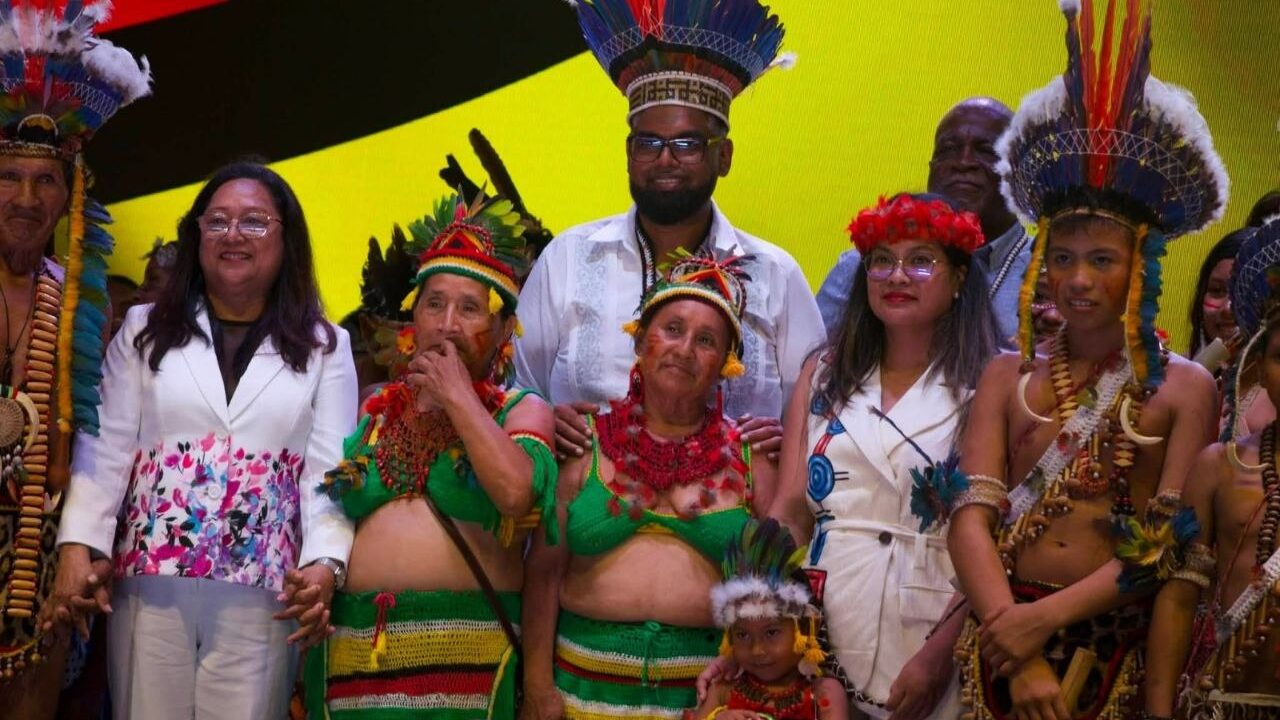
Speaking at the opening of Amerindian Heritage Month 2026 at Sophia, Greater Georgetown, the President said his administration’s investments in hinterland communities are aimed at ensuring that Indigenous people benefit directly from Guyana’s economic growth.
“The investments we are making for the benefit of our Indigenous brothers and sisters [are] what it means to translate economic growth into development,” Ali said.
He said the objective is to ensure that Indigenous peoples are “not spectators” in Guyana’s transformation, but “participants and beneficiaries of it.”
The Head of State told the gathering that Amerindian communities occupy a special place in Guyana as the country’s first people, adding that their history, culture, traditional practices and knowledge must always be respected.
“In our Guyana, the Amerindian community occupies a special place as our first people,” he said. “This is a circumstance we must never forget and must always honour.”
The President said his government had invested more than $41.7 billion in Indigenous villages and communities over the past five years.
He pointed to several areas of investment, including the Amerindian Development Fund, presidential grants, the Low Carbon Development Strategy, agriculture, energy, roads, education, healthcare, housing, water, safety and economic empowerment.
According to Ali, $21.7 billion was invested through the Amerindian Development Fund, while almost $3 billion went to communities through the restored presidential grant. He said the Low Carbon Development Strategy also delivered $14.2 billion to villages over the past five years.
In agriculture, Ali said more than $1 billion was invested, helping villages acquire almost 300 tractors, along with boats, outboard engines, minibuses, pickups, ATVs, trucks and canters.
He said the scale of development has changed expectations in Indigenous communities.
The President recalled that years ago, one of the biggest requests from Amerindian communities was for sewing machines. Today, he said, communities are requesting ATVs, minibuses, hospital theatres and training opportunities for young people.
“That by itself demonstrates the fact that our expectations have changed,” Ali said.
He also highlighted major investments in energy, saying more than $11 billion had been spent on hinterland energy projects, including hydropower, solar farms and household solar systems.
Ali said hinterland generating capacity had increased from 1.62 megawatts to almost 17.5 megawatts, describing it as a “revolution in energy” led by Prime Minister Mark Phillips.
The President said the government did not make those investments based only on financial return, but because of what they would deliver for communities.
“What we know is what the investment will deliver — stronger villages, greater dignity,” he said.
On infrastructure, Ali said 79 kilometres of paved roads, 71 kilometres of asphaltic roads, more than 1,200 kilometres of laterite roads and almost 100 structures were delivered in hinterland communities and villages. He also said about 2,400 kilometres of road corridors were maintained, with another 1,098 kilometres maintained separately in Region Nine.
He said Indigenous teams are now helping to build roads across the country, including along the coast, because of investments made in their capacity.
Ali also used the occasion to call on telecommunications companies to do more for hinterland connectivity.
He said his government had invested US$19.6 million in ICT, benefiting 140,000 people directly.