President Dr. Irfaan Ali has defended Guyana’s new migration arrangement with the United States, insisting the country retains the right to reject anyone proposed for relocation and to conduct its own vetting before agreeing to accept them.
The Guyanese Leader made the comments during an interview with Al Jazeera, where he was asked about Guyana’s decision to receive third-country nationals removed from the United States and concerns that the arrangement could leave the country handling Washington’s immigration cases.
The President said Guyana has not surrendered control over who enters the country under the agreement.
“I don’t see this as a precedent because we can reject. We can say that we are not accepting this,” President Ali said, adding that Guyana has “full control over what we accept.”
He said the names of individuals are provided in advance, and Guyanese authorities conduct their own checks before giving approval.
“We do our own vetting to our own satisfaction, and then we agree with the names,” Ali said. He stressed that the arrangement does not allow the United States to unilaterally send people to Guyana without the Government’s consent.
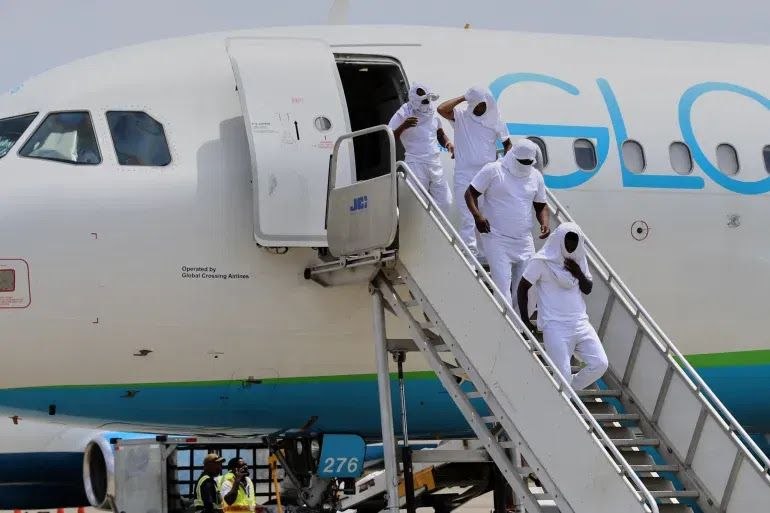
His comments come just over a week after Guyana received its first group of six third-country nationals removed from the United States.
The group, comprising four Cuban nationals and two Afghans, arrived in Guyana on September 4 after being vetted and found to have no criminal backgrounds. Reports said the six, ranging in age from 20 to 36, had been removed from the United States primarily over immigration matters.
Foreign Secretary Robert Persaud had said that the individuals were vetted by Guyanese authorities before their arrival and that, at the time, the United States had made no further request for additional persons to be sent to Guyana.
The arrivals followed months of negotiations between Georgetown and Washington over a migration cooperation framework.
The Government formally announced on September 5 that it had concluded the framework with the United States, allowing Guyana to receive a “limited, vetted number of skilled and non-criminal individuals” through the International Organization for Migration’s Assisted Voluntary Return Programme.
Under the framework, Guyana retains full discretion to review and reject any person proposed for relocation. The United States is responsible for the full cost of the relocation process, while the Government has said it intends to accept only individuals who voluntarily agree to come to Guyana.
The IOM is responsible for implementing the programme, including receiving, housing and supporting those relocated to Guyana. It is also expected to provide assistance with integration and access to communication with legal representatives and family members.
The Guyana Government has said taxpayers will not bear the financial cost of the programme. The arrangement is also not intended to provide permanent settlement in Guyana.
Those relocated will remain in the country while their immigration status is determined. Depending on the outcome, they may return to their country of origin or relocate to another country of their choosing. The framework also preserves their right to seek international protection, with the IOM expected to refer eligible cases to the United Nations High Commissioner for Refugees in coordination with Guyanese authorities.
During the Al Jazeera interview, President Ali also pointed to the IOM’s role in administering the initiative, while arguing that accepting migrants is not unfamiliar territory for Guyana.
He noted that Guyana already hosts migrants from countries including Venezuela and Cuba and said they are able to access social services.
The President was challenged during the interview over whether the agreement could establish a precedent for the United States to send larger numbers of deportees to Guyana