President Dr. Irfaan Ali says Guyana is prepared for any reaction from Venezuela when the International Court of Justice (ICJ) delivers its long-awaited final judgment in the border case between the two neighbouring South American states.
Both Guyana and Venezuela are now awaiting the Court’s ruling after concluding their final oral arguments on the merits of the case in May, bringing the years-long legal proceedings into their final phase.
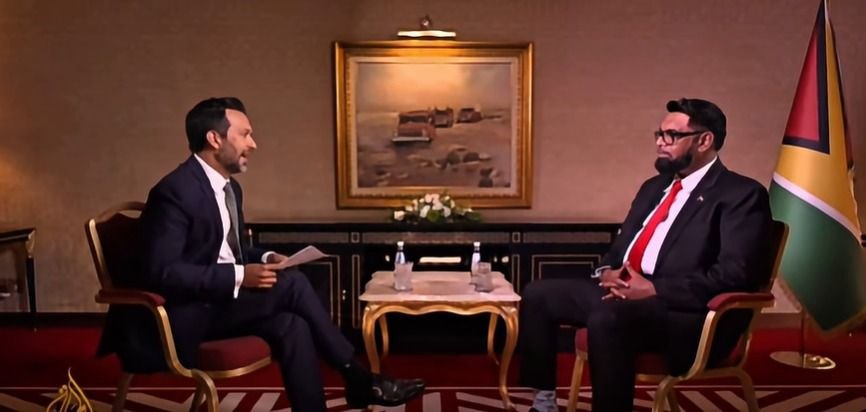
Speaking in an interview with Al Jazeera, President Ali said Venezuela’s rhetoric around the controversy has eased substantially, but Guyana remains aware of Caracas’ position and is prepared for what may follow the judgment.
“I wouldn’t say we are bracing, but we are prepared for any reaction to the court ruling,” Ali said.
The President said his government remains confident in Guyana’s case and expressed hope that a ruling could come early in the new year.
He said that once the Court settles the legal question, the focus should shift towards building a relationship between Guyana and Venezuela in which both countries can pursue their economic potential without fear.
“We are very confident, and after that it is about working with our neighbours with an understanding clearly that this will be something behind us,” Ali said.
In May, the ICJ heard hearings from both countries. The hearings were held at the Peace Palace in The Hague from May 4 to May 11, 2026, with both countries presenting two rounds of oral arguments. The Court is now deliberating and will issue a final judgment that is legally binding on both parties.
Guyana’s government has said that, based on the normal timeframe for an ICJ judgment following the close of oral hearings, a decision could come between November 2026 and January 2027. No formal date has yet been announced, and the Court is expected to notify the parties ahead of the public sitting at which the judgment will be delivered.
During the May hearings, Guyana asked the Court to affirm that the 1899 Arbitral Award, which established the boundary between then-British Guiana and Venezuela, is legally valid and binding.
Guyana maintains that the award constituted a full and final settlement of the boundary and that Venezuela recognised and respected that boundary for more than six decades before challenging it.
Venezuela, however, argued that the 1899 award resulted from fraud and collusion and maintained that the 1966 Geneva Agreement provides the mechanism through which the controversy should be resolved by negotiation rather than through judicial determination.
In its final submissions on May 8, Guyana went further, asking the ICJ to affirm that the boundary established by the 1899 award and subsequently demarcated under the 1905 agreement is the lawful international boundary between the two states.
Guyana also asked the Court to order Venezuela to withdraw from the Guyanese portion of Ankoko Island and to repeal laws and measures that Guyana says seek to annex the Essequibo region or undermine its sovereignty and territorial integrity.
Venezuela delivered its final arguments on May 11.
Acting Venezuelan President Delcy Rodríguez personally addressed the Court during the closing session and reiterated Caracas’ longstanding position that it does not recognise the ICJ’s authority to settle the controversy.
Rodríguez said Venezuela would not recognise a judicial decision arising from the proceedings and maintained that the matter should instead be resolved under the Geneva Agreement. Ali acknowledged that position during his Al Jazeera interview.
“We are very conscious of these words, also very conscious of Delcy’s position in relation to not accepting the ruling,” he said, while noting that Venezuela nevertheless participated in the proceedings.
Guyana formally approached the ICJ in March 2018, seeking confirmation of the legal validity and binding effect of the 1899 Arbitral Award.
The case followed a decision by then-United Nations Secretary-General António Guterres to choose the ICJ as the means of settlement after decades of efforts under the 1966 Geneva Agreement failed to resolve the controversy.
The ICJ ruled in December 2020 that it had jurisdiction to consider Guyana’s claim concerning the validity of the 1899 award and the definitive settlement of the land boundary.
Venezuela subsequently raised a preliminary objection, but the Court rejected it in April 2023 and ruled that it could proceed to examine the merits of Guyana’s case.
The Court has also issued provisional measures while the substantive case remained pending.
In December 2023, amid heightened tensions surrounding Venezuela’s referendum on Essequibo, the ICJ unanimously ordered Venezuela to refrain from any action that would alter the situation in the territory administered and controlled by Guyana.
Essequibo comprises roughly two-thirds of Guyana’s landmass and has been administered by Guyana and, before independence, British Guiana for generations.
The case followed a decision by then-United Nations Secretary-General António Guterres to choose the ICJ as the means of settlement after decades of efforts under the 1966 Geneva Agreement failed to resolve the controversy.
The ICJ ruled in December 2020 that it had jurisdiction to consider Guyana’s claim concerning the validity of the 1899 award and the definitive settlement of the land boundary.
Venezuela subsequently raised a preliminary objection, but the Court rejected it in April 2023 and ruled that it could proceed to examine the merits of Guyana’s case.
The Court has also issued provisional measures while the substantive case remained pending.
In December 2023, amid heightened tensions surrounding Venezuela’s referendum on Essequibo, the ICJ unanimously ordered Venezuela to refrain from any action that would alter the situation in the territory administered and controlled by Guyana.
Essequibo comprises roughly two-thirds of Guyana’s landmass and has been administered by Guyana and, before independence, British Guiana for generations.