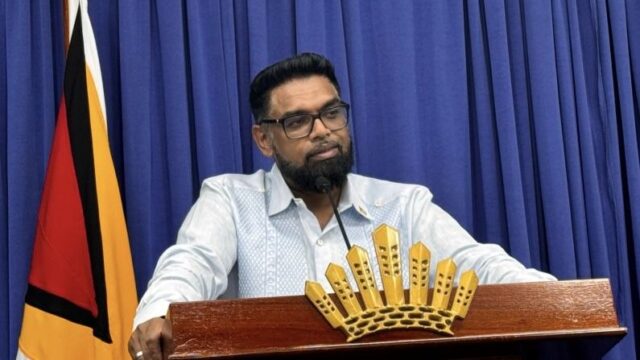
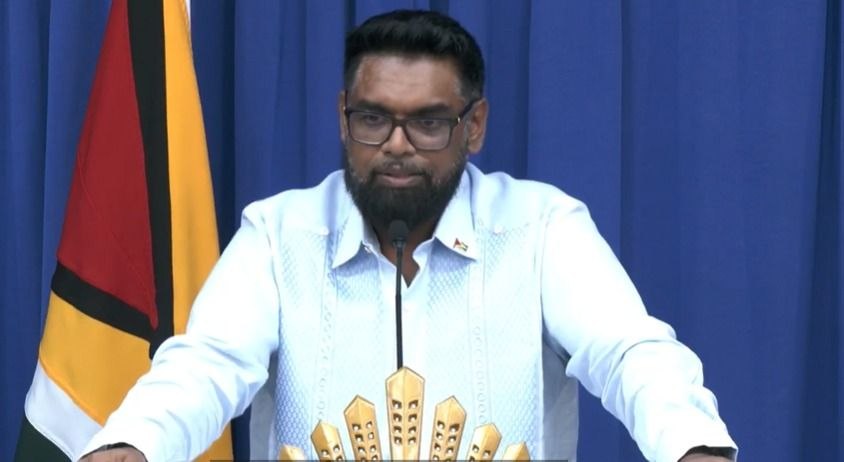
Guyana’s economy expanded by an estimated 33.3 per cent during the first half of 2026, while the non-oil economy recorded growth of 10.1 per cent, President Irfaan Ali disclosed on Monday.
Ali, during an address on the country’s economic performance, said the full-year growth forecast has now been revised to 20.8 per cent for the overall economy and 10.2 per cent for the non-oil economy.
If realised, the President said, this would mark the sixth consecutive year of growth in the non-oil economy following its contraction in 2020.
The expansion during the first six months was led by mining and quarrying, which grew by an estimated 40.7 per cent. Within that sector, oil and gas expanded by 41.3 per cent, while gold mining grew by 11.3 per cent and bauxite by 7.3 per cent.
Other mining activities, including sand, stone, manganese and diamond, recorded estimated growth of 40 per cent.
Ali said he was particularly pleased with the performance of the gold industry, pointing to measures introduced late last year aimed at improving declarations, accountability and transparency in the sector.
Construction also remained a significant contributor, expanding by 24.7 per cent during the first half.
The President noted that the latest construction figure represents growth on top of the expansion recorded during the corresponding period last year.
“This growth is already on a heavy base because this is year-on-year growth,” Ali said.
The services sector, meanwhile, grew by an estimated 7.2 per cent, while manufacturing expanded by three per cent.
However, agriculture, forestry and fishing collectively contracted marginally by 0.5 per cent during the first half.
Within agriculture, sugar production increased by 19.3 per cent and rice by 4.4 per cent, while the other crops subsector contracted by 6.4 per cent. Ali attributed some of the difficulties to weather conditions as well as transportation, logistics and higher input costs.
Forestry grew by an estimated 15.4 per cent, while fishing expanded by 4.1 per cent.
The President also pointed to increased lending as another indicator of economic activity.
At the end of the first half of the year, net domestic credit stood at G$1.286 trillion, 15.5 per cent above its December 2025 position. Credit to the private sector increased by 11.5 per cent, while credit to households rose by 14.6 per cent to G$75.8 billion.
Real estate mortgages also expanded by 21.2 per cent.
“Isn’t this an economy that is healthy? Isn’t this an economy that is demonstrating strength, that is demonstrating diversification, that is demonstrating structural stability?” Ali questioned.
On inflation, Ali reported that the 12-month rate stood at four per cent at the end of June. Inflation is now projected at 4.3 per cent by the end of 2026.
He argued that containing inflation at that level represented effective management of the economy, particularly against increases in international fuel prices.
Meanwhile, the President reported that the Natural Resource Fund (NRF) held a balance of US$4.294 billion at the end of June.
Ali said the figures demonstrate the progress being made across the economy, arguing that the country’s economic performance should be assessed based on the available data.
“This is what we should be debating: facts from fiction,” the President said.