Prominent Guyanese economist Joel Bhagwandin has credited former President Bharrat Jagdeo with playing a central role in Guyana’s economic recovery, pointing to a dramatic reduction in the country’s external debt burden, lower inflation, stronger foreign reserves and a more stable exchange rate by the time Jagdeo left office in 2011.
In a lengthy reflection on Guyana’s political and economic history, Bhagwandin argued that Jagdeo’s period in government must be considered against the severe economic conditions inherited by the People’s Progressive Party/Civic (PPP/C) when it took office in 1992.
According to Bhagwandin, Guyana entered that period with a severely distressed economy and an enormous external debt burden.
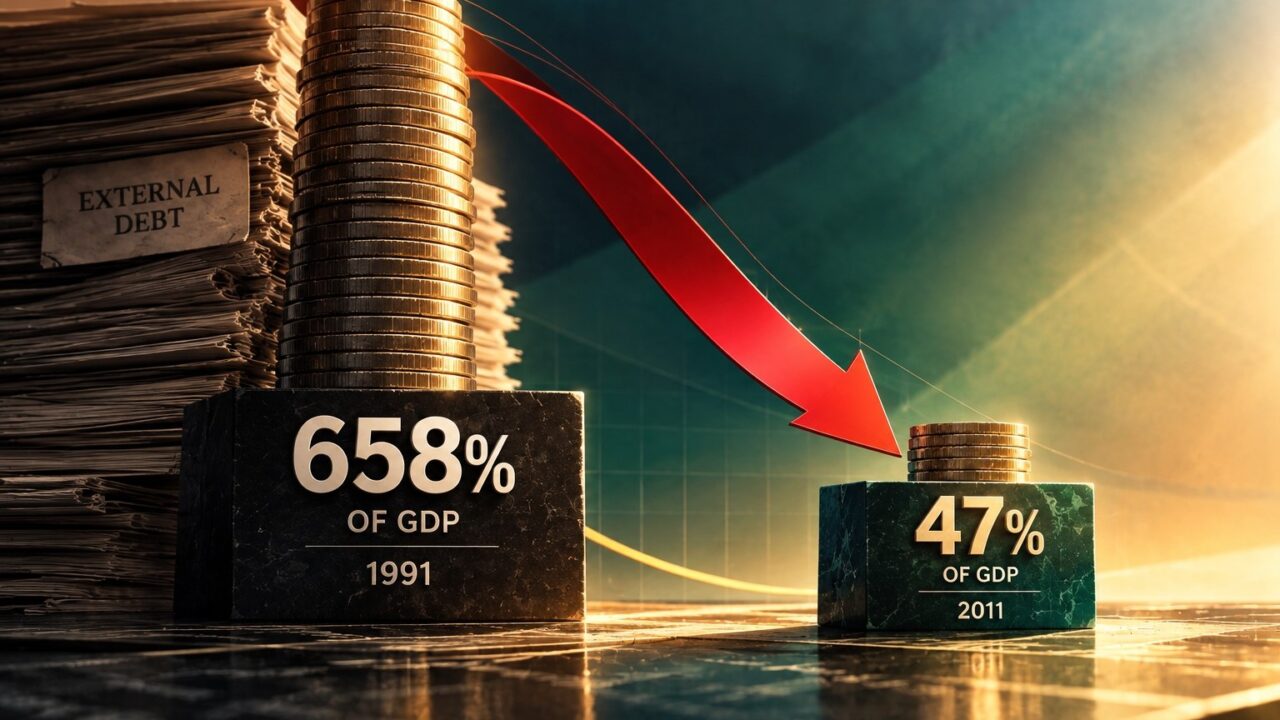
“The PPP/C inherited a severely distressed economy in 1992. World Bank analysis placed external debt at about six times GDP at the end of 1991; the 2012 Budget Speech later recorded its decline from 658% of GDP in 1991 to 47% by the end of 2011,” Bhagwandin wrote.
That 658% to 47% decline is supported by Guyana’s 2012 Budget presentation, which reported that external debt had fallen from 658% of Gross Domestic Product (GDP) at the end of 1991 to 47% by the end of 2011. The Budget also reported that the country’s external reserves had tripled since 2006 to US$798 million.
Bhagwandin noted that Jagdeo entered Parliament in 1992 before becoming Special Adviser and later Minister of Finance. He subsequently became Second Vice President in 1997 and President in August 1999.
He argued that Jagdeo was therefore involved in Guyana’s economic management during both the earlier recovery period and, later, as President when the country continued efforts to reduce its debt and strengthen its fiscal position.
The IMF recorded that Guyana’s real GDP grew by an average of approximately 7.5% annually between 1991 and 1994, as economic activity recovered alongside changes in economic policy. The Fund attributed the improvement partly to renewed confidence, increased investment and stronger production in sectors including sugar and rice.
Inflation also fell sharply from the extremely high levels experienced at the beginning of the 1990s.
IMF historical figures show annual average consumer price inflation at 101.5% in 1991, while end-of-period inflation stood at 83.1%. By 1992, those measures had fallen to 28.2% and 13.8%, respectively.
By 2011, official Guyana figures placed inflation at just 3.3%.
Bhagwandin said the wider transformation was also reflected in Guyana’s foreign reserves and currency stability.
“The turnaround is visible in the national balance sheet. Between 1991 and the end of 2011, external debt fell from approximately 658% to 47% of GDP, debt service declined from more than 150% to around 30% of revenue, and inflation fell from 87% to low single digits,” he stated.
He continued: “The exchange rate stabilized at around GYD 200 to USD 1, while gross international reserves rose to approximately USD 750mn–USD 800mn, or four and a half months of imports.”
Official figures show that the Bank of Guyana ended 2011 with US$798.1 million in external reserves, equivalent to approximately 4.2 months of imports. The Guyana dollar ended that year at G$203.75 to US$1, compared with G$203.50 at the end of 2010.
Bhagwandin contended that these gains were particularly significant because they were achieved before Guyana began producing oil and during a period marked by major domestic and external shocks.
Jagdeo served as President from 1999 to 2011, during which Guyana faced political unrest and a serious security crisis, as well as the devastating 2005 floods and the 2008–2009 global financial crisis.
Despite those challenges, Bhagwandin argued that Guyana emerged from the period with a considerably stronger economic foundation than it had at the beginning of the 1990s.
“Stability did not descend naturally upon Guyana; it was constructed under pressure,” the economist wrote.
Kevin:
He said Jagdeo’s economic record should therefore be considered in the context of the resources and fiscal space available at the time, rather than measured against present-day Guyana, where petroleum revenues have significantly expanded the Government’s financial capacity.
“His record should be judged by recovery and stability: reducing debt, restoring fiscal and monetary credibility, rebuilding reserves, containing inflation, stabilizing the currency, reviving investment, sustaining the State through a security crisis and developing a strategy without petroleum revenues,” Bhagwandin stated.
However, Guyana’s economic recovery across the 1990s and 2000s was not the work of a single administration or individual. The Economic Recovery Programme began under the Hoyte administration in 1988, with market-oriented reforms, exchange-rate changes, privatisation and restructuring already underway before the PPP/C entered office in 1992. IMF records show that by 1991 the economy had begun responding to those reforms.
Subsequent administrations continued that recovery process, while Guyana also benefited from substantial international debt-relief initiatives and agreements with creditors.
Bhagwandin nevertheless argued that Jagdeo became a central figure in the continuation of that economic restructuring, first through the Ministry of Finance and later during his 12 years as President.
He maintained that this period helped move Guyana from an economy struggling with extraordinary debt, inflation and limited fiscal space towards one with substantially lower debt ratios, stronger reserves and greater macroeconomic stability by the end of 2011.