Guyana’s rapid oil-driven economic expansion has been accompanied by a declining public debt-to-GDP ratio, rising government revenues and stronger external balances, according to the World Bank.
In its October 2026 Latin America and the Caribbean Economic Update, the Bank singled out Guyana as a regional standout, noting that the country has recorded exceptionally rapid and sustained economic growth since the start of oil production.
“Guyana stands out within the region, having recorded exceptionally rapid and sustained GDP growth since 2020, driven by the scaling up of offshore oil production,” the World Bank said.
Importantly, the Bank said that expansion has coincided with improvements in several of the country’s key fiscal and external indicators.
“This expansion has been accompanied by rising fiscal revenues, improved external balances, and a declining public-debt-to-GDP ratio,” the report stated.
The debt-to-GDP ratio measures a country’s public debt relative to the size of its economy. In Guyana’s case, the World Bank’s assessment indicates that the debt burden relative to the rapidly expanding economy has been declining.
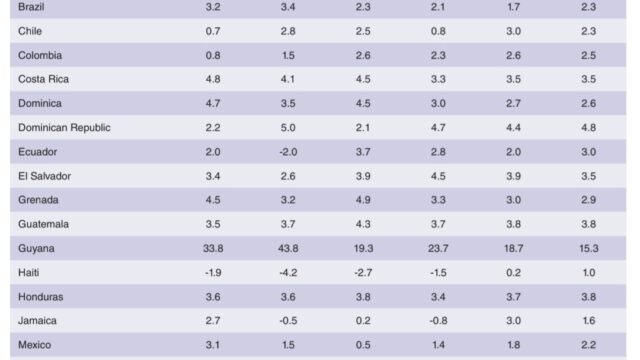
The Bank’s assessment comes as Guyana continues to record growth rates far above its regional counterparts. Its Caribbean growth table shows the economy expanded by 43.8% in 2024 and 19.3% in 2025, while growth for 2026 is estimated at 23.7%. By comparison, neighbouring Suriname is expected to grow by 3.9% this year, while Trinidad and Tobago is projected to contract by 0.2%.
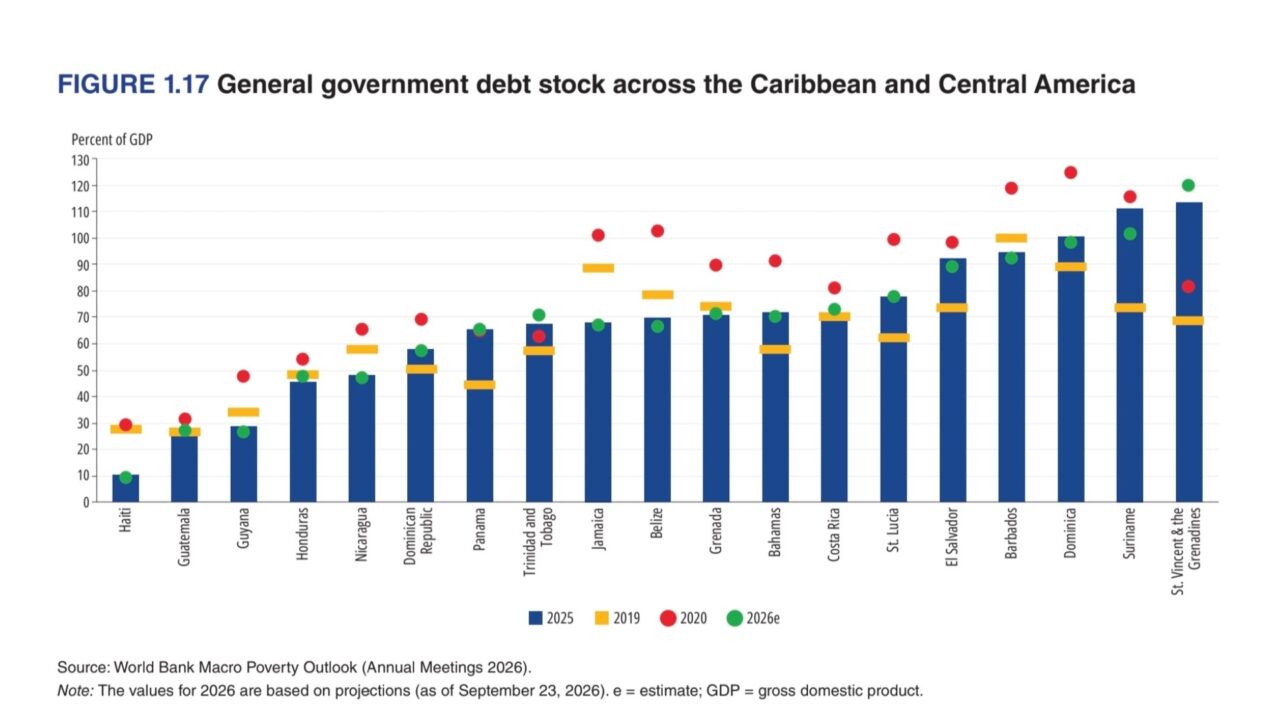
The World Bank noted that debt conditions vary considerably across the Caribbean and Central America, with several countries reducing their debt-to-GDP ratios through economic growth and fiscal consolidation.
Its regional debt comparison shows Guyana among the countries with a relatively lower government debt burden as a share of GDP, while several Caribbean economies continue to carry considerably heavier debt loads. The Bank’s Figure 1.17 compares general government debt across the Caribbean and Central America using 2019, 2020, 2025 and estimated 2026 levels.
However, the Bank cautioned that Guyana’s improved position does not remove the challenges associated with managing a rapidly expanding oil economy.
It warned that oil-producing countries such as Guyana face the parallel challenge of “managing revenue volatility and avoiding procyclicality as public finances expand rapidly.”
The World Bank also said the extraordinary pace of Guyana’s growth increases the importance of strengthening the systems responsible for managing the country’s expanding resources.
It said Guyana must focus on “strengthening public investment management, building institutional capacity, and ensuring that oil wealth translates into broad-based and inclusive development.”
Guyana’s debt trajectory also comes against a more difficult regional backdrop. The World Bank said public debt ratios across Latin America and the Caribbean have generally stabilised following their pandemic-era increase but remain high by historical standards, with many countries facing limited fiscal space and elevated borrowing costs.
For Guyana, however, the combination of rapid GDP growth, increased fiscal revenues and improved external balances has contributed to a falling debt burden relative to the size of the economy, even as the country faces the longer-term task of ensuring its expanding oil revenues are managed sustainably.