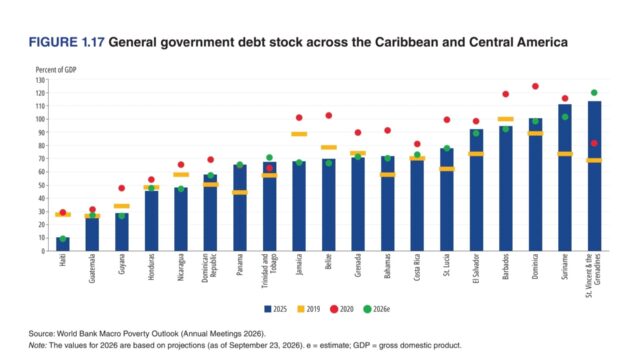

Guyana’s rapid oil-fuelled expansion is increasingly separating it from much of the Caribbean, with the World Bank warning of a deepening structural divide between the region’s resource-rich economies and countries heavily dependent on tourism and services.
In its October 2026 Latin America and the Caribbean Economic Update, the Bank describes the Caribbean as operating on a “dual-track” growth path, with Guyana’s unprecedented expansion significantly lifting the economic performance of the subregion as a whole.
“Within the Caribbean, the macroeconomic landscape is characterized by a stark divergence,” the Bank said.
On one side of that divide is Guyana, where oil production continues to drive growth at levels unmatched by its Caribbean neighbours. The Bank said Guyana’s “unprecedented oil-driven expansion continues to pull up the subregional averages,” alongside accelerating offshore-related investment in Suriname and Trinidad and Tobago’s more mature natural gas sector.
The contrast is particularly sharp when the individual growth projections are examined.
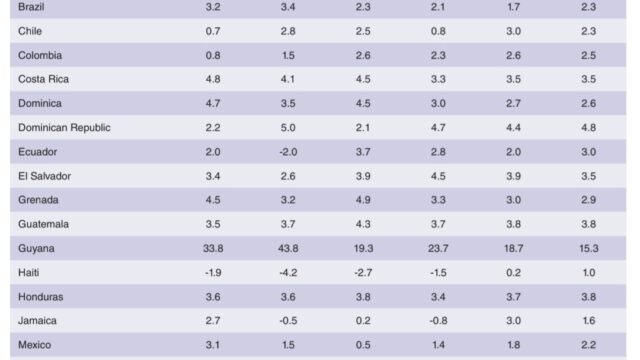
Guyana’s economy is projected to expand by 23.7% in 2026, following growth of 43.8% in 2024 and 19.3% in 2025. Although growth is expected to moderate as the economy becomes larger, the Bank is still forecasting expansions of 18.7% in 2027 and 15.3% in 2028.
Suriname, meanwhile, is projected to grow by 3.9% this year and 4.6% in 2027 before surging by 21.5% in 2028.
The picture is considerably different for many of the Caribbean’s tourism-dependent economies.
According to the Bank, growth among those countries has moderated as they contend with softer demand from overseas, persistent import and energy costs and recurring exposure to climate-related shocks. The Bank said the widening gap points to a “deepening structural divide” between commodity exporters and service-reliant Caribbean economies.
For 2026, The Bahamas is projected to grow by 3%, Barbados by 2%, Belize by 2.4%, Dominica by 3%, Grenada by 3.3% and St. Vincent and the Grenadines by 2.6%. St. Lucia is forecast to expand by just 1.1%.
At the other end, Jamaica is projected to contract by 0.8% this year, while Trinidad and Tobago is expected to decline by 0.2%.
The Bank noted that the divide comes against a broader regional environment in which food- and energy-importing Caribbean economies are being squeezed by higher import costs and softer tourism demand. It also pointed to global uncertainty, limited fiscal space and high real borrowing costs as pressures on economic activity across Latin America and the Caribbean.
The report said Latin America and the Caribbean as a whole is expected to grow by only 2.2% in 2026, slightly below the 2.4% recorded in 2025. It cautioned, however, that the regional figure masks substantially different economic paths among individual countries.
In the Caribbean, nowhere is that difference more pronounced than in Guyana, where the pace of oil-driven growth is not only putting the country far ahead of its neighbours but is now strong enough to lift the growth averages for the wider subregion.
The World Bank said the Caribbean’s emerging two-track picture ultimately reflects a widening economic divide between countries benefiting from abundant natural resources and those still heavily reliant on tourism and other services for growth.