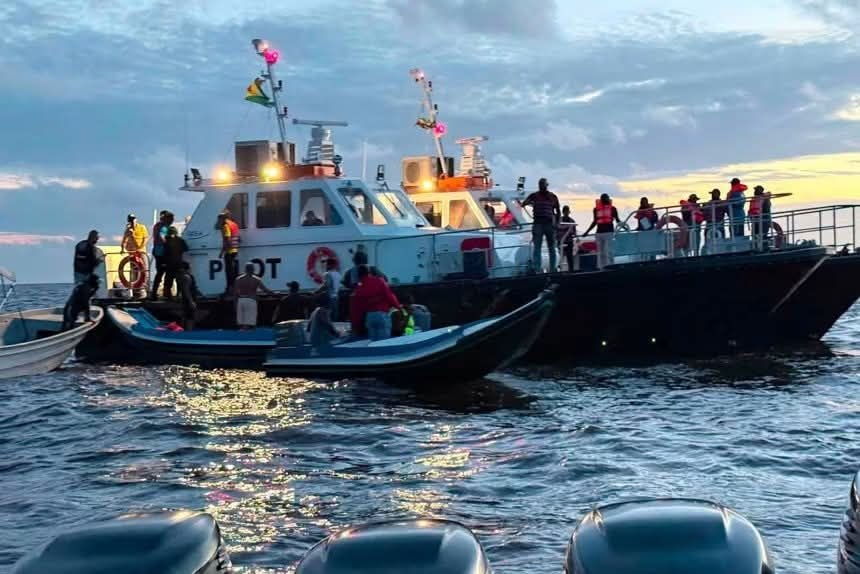
The Commission of Inquiry into the MV Barima tragedy on Wednesday began examining the emergency response to the vessel’s distress signals, with testimony revealing that the first alert was picked up at 10:43 PM on July 18, while the Guyana Defence Force (GDF) Coast Guard was contacted at 10:51 PM.
Rickford Samaroo, Director of the Air Navigation Services Department at the Guyana Civil Aviation Authority (GCAA), was the first witness called when substantive proceedings opened at the Arthur Chung Conference Centre.
During his testimony, Samaroo explained how Guyana relies on COSPAS-SARSAT, an international satellite-based system that detects distress beacons and helps authorities locate emergencies requiring search and rescue assistance. He said the system picked up the MV Barima’s signal, prompting the activation of the emergency response process.
Samaroo told the Commission that the established Standard Operating Procedures were followed and committed to submitting communications connected to his involvement in the incident.
The inquiry also heard from Tia Valenzuela, who was on duty in the control room at the Cheddi Jagan International Airport when the distress alerts came in.
Valenzuela testified that the United States Mission Control Centre transmitted the initial alert at 10:43 PM. After confirming that the signal was coming from a vessel rather than an aircraft, she began plotting the coordinates to identify its location.
While she was working to determine the vessel’s position, six further distress messages were received.
According to her testimony, she contacted the GDF Coast Guard through WhatsApp at 10:51 PM and received a reply at 10:52 PM. She also explained that the required procedures included acknowledging the distress signals in the computer system.
Valenzuela further disclosed that she communicated with GDF Coast Guard Commanding Officer David Shamshuddin regarding the incident.
The Commission is continuing to investigate the circumstances surrounding the MV Barima tragedy, including how the distress alerts were handled, how quickly the relevant authorities were informed and the overall coordination of the search and rescue response.