
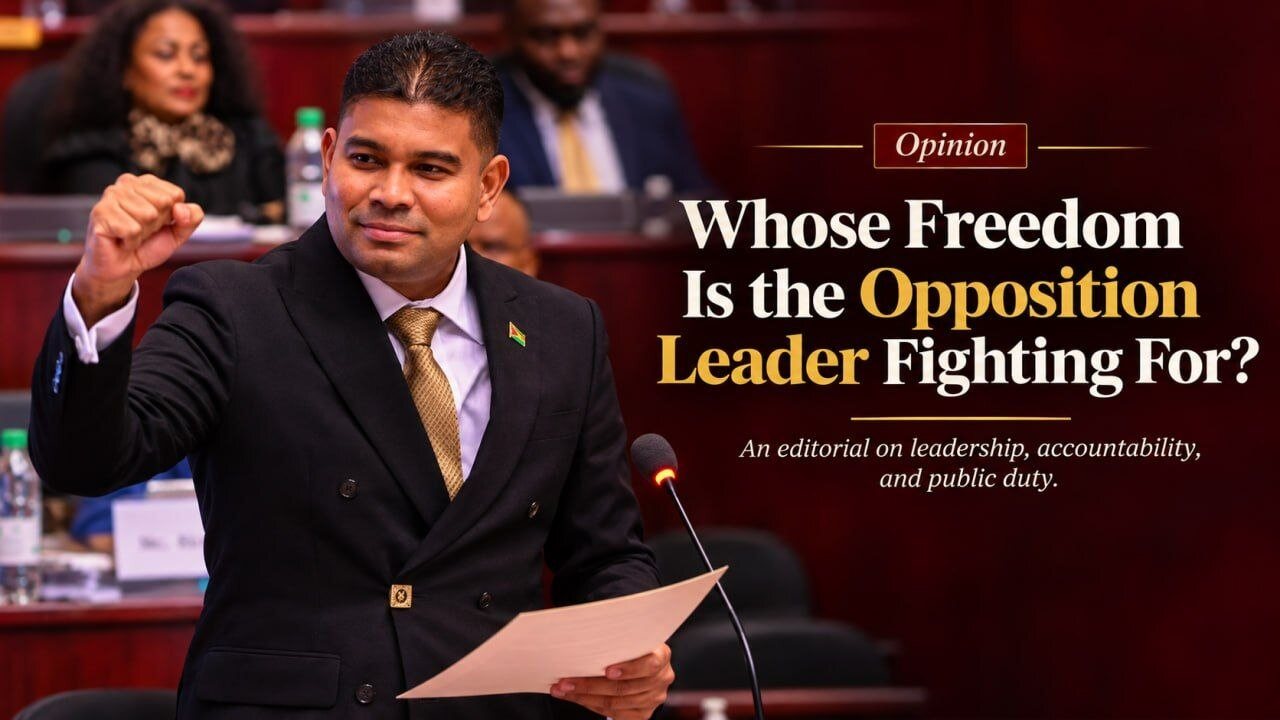

Dear Editor,
Fourteen months after the 1 September 2025 election, and more than nine months into his tenure as Leader of the Opposition, Azruddin Mohamed has answered the question of why he entered politics. Not his critics. His record. There has been only one cause, and it is his own.
The facts need little elaboration. In June 2024, the US Treasury sanctioned him and his father, Nazar Mohamed, under the Global Magnitsky framework for public corruption and the alleged evasion of more than US$50 million in duties on gold exports. Within a year, he had launched WIN. Within weeks of the election, a federal grand jury in Florida had indicted both men on eleven counts, including wire fraud and money laundering. On 31 October 2025, they were arrested on a US extradition request. In January 2026, he became Leader of the Opposition and declared the Government "afraid of me." His reply to the National Budget was a headline, not an alternative. Nine months later, there is still no costed programme. The only programme on offer is his own defence.
Since then, his energy has gone into the courts, not the National Assembly: the Caribbean Court of Justice, the Court of Appeal and a constitutional challenge to the Fugitive Offenders Act. Even PNCR leader Aubrey Norton has made clear that his party will not join any fight to shield him from surrender to the United States. Then came October. Shots were fired outside the Kitty home of Senior Superintendent Prem Narine, the key witness in the extradition case. Mr Mohamed calls it an assassination attempt; the police dispute that account. He and two staff members were charged with firearm offences and with attempting to obstruct the course of justice. Days later, police alleged that a constable had sold him surveillance footage of that night for $800,000. He played it at a press conference. On 30 October, he was remanded to prison on a cybercrime charge.
Magistrate Abigail Gibbs refused bail on grounds any first-year law student would recognise. Under the Bail Act 2022, she weighed a simple fact: Mr Mohamed was already on bail in his other matters and now stood accused of a fresh offence allegedly committed while on bail. She found a likelihood that further offences could follow. That is not persecution. That is the law doing its job, applied to an accused who, on the prosecution's case, keeps adding to his own charge sheet.
His apologists did not answer with law. They answered with a smear campaign. Photographs of Magistrate Gibbs and a person said to be her partner were circulated, laced with insinuations of a quid pro quo and not a shred of evidence. Attorney Selwyn Pieters was compelled to plead publicly for the posts to come down: such allegations belong before the Judicial Service Commission, not on social media. Mr Mohamed's lawyers had already announced appeals to three courts. The remedy lay in the law. The trolling was about intimidation.
Now consider Chief Magistrate Judy Latchman, who presides over the extradition hearing. It opened on 6 January 2026. Ten months on, only two prosecution witnesses have testified, and both remain under cross-examination. The prosecution calls it "a masterclass in delay"; the Chief Magistrate says "rushed justice is crushed justice." Not a word from the apologists. Their standard is transparent: a magistrate is independent when she grants time and compromised when she refuses bail. That is not judicial independence. It is a scorecard.
The State has three arms, and the judiciary is no appendage of the executive. No family knows this better than the Mohameds. On 2 July 2026, Justice Gino Persaud quashed some $800 million in taxes the Guyana Revenue Authority had imposed on his sister Hana and on Bibi Mohamed over a Ferrari and a Rolls-Royce, branding the Commissioner General's conduct "unreasonable, arbitrary, irrational, unfair, and unlawful." On 29 October, the High Court freed the constable's mother because the State could not justify her detention.
These are the courts the family now calls captured. No one gets to celebrate the judiciary in July and vilify it in October.
Then there is Constable Ryan Greene, twenty years old and remanded to prison on the same charge. Police allege the $800,000 that bought the footage was delivered on Mr Mohamed's behalf. The constable's mother was detained over part of that money until the High Court ordered her release. His father, Randy Greene, was left to fight for them alone. And what did the Mohamed camp offer this family? His attorney said Mr Mohamed "does not know this young man." His sister, Hana Mohamed, confronted by the family, was caught on video putting it more plainly: "collateral damage."
Remember those two words. They are the most honest thing the Mohamed camp has said all year. A young man's liberty and career in the balance, a mother detained, a father fighting in court alone, all written off as the price of one man's defence. Mr Mohamed has senior counsel and appeals in three courts. The constable has no one but his family. That is the moral arithmetic of this Opposition: one man is the cause, and everyone else is collateral damage.
The last Opposition lived in the courts too. The difference is whom it went there for. When the Granger administration revoked the leases of West Berbice rice farmers, PPP counsel stood with them, and the High Court struck the revocations down. When the US$18 million ExxonMobil signing bonus surfaced in an undisclosed account at the Bank of Guyana, the PPP went to court to have it paid into the Consolidated Fund, and the money was moved. When the Government tried to outlast a no-confidence motion, the PPP went to the Caribbean Court of Justice and won. Farmers' land. The public purse. The Constitution. Every case served someone other than the litigant. Today's version has exactly one client.
The same selectivity runs through the family's public advocacy. His sister, Hadiyyah Mohamed, wrote a master's dissertation in political science on alleged corruption under the PPP, a work that leans on opinion and perception rather than adjudicated fact. Yet the gravest international corruption case ever to involve Guyanese nationals sits within her own family: US Treasury sanctions on her father and brother, and the designation of Hadi's World, a company that bears her name. Scholarship that interrogates everyone except one's own household is not scholarship. It is advocacy with footnotes.
Strip away the slogans and the matter is plain. The allegations against the Mohameds were not manufactured at Freedom House or State House. They come from the US Treasury, the US Department of Justice and a federal grand jury in Florida. The Guyana Revenue Authority even withdrew its own local charges because they overlapped with the US case. Guyana's role is narrow: honour its treaty obligations and let its courts decide. This is not Opposition versus Government. It is a family fighting for its own freedom from alleged crimes that Washington, not Georgetown, wants to try.
The constable is not the only casualty. The Leader of the Opposition holds a constitutional office, and legal jeopardy does not suspend its duty. Yet every major public move he has made this year leads back to the same place. The constitutional challenge targets the very law that governs his surrender. The press conferences are about his case. The protests are against his prosecution. The appeals to three courts were filed for his release. Even the attacks on a magistrate were over his bail. He has turned the machinery of a parliamentary opposition into a personal legal strategy.
The presumption of innocence stands; the courts, in Georgetown and if need be in Florida, will settle the criminal questions. But political judgement rests on the record, and the record is damning. Every appeal, every protest, every attack on a magistrate has served one cause. Anyone in its path is collateral damage. Guyanese voted for an Opposition. They got a legal defence fund with a seat in Parliament.
Yours faithfully,
Concerned Citizen Letter