
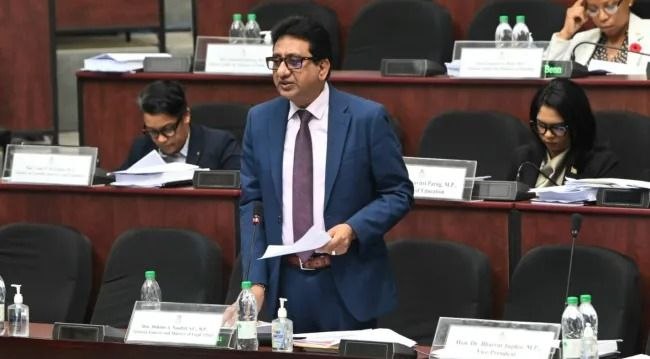

The criminal justice system could soon benefit from an expanded range of sentencing options, including court-ordered curfews and electronic monitoring, under legislation introduced in the National Assembly on Wednesday.
The Criminal Justice (Alternative Sentencing) Bill 2026, presented by Attorney General and Minister of Legal Affairs Anil Nandlall, SC, received its first reading during the sixth sitting of the Thirteenth Parliament.
The proposed legislation seeks to modernise Guyana’s sentencing framework by providing judicial officers with additional measures for dealing with persons convicted of certain less serious offences.
These measures include curfew orders, community service and other non-custodial sentencing arrangements, which would allow courts to impose appropriate penalties without necessarily requiring offenders to serve prison sentences.
A significant feature of the bill is the proposed introduction of curfew orders, which would allow courts to require convicted persons to remain at designated locations during specified hours.
The legislation would empower judicial officers to determine the conditions of those orders, taking into consideration the circumstances of the offender and the nature of the offence.
Under the proposed framework, courts would also be required, as far as practicable, to consider an offender’s employment, educational commitments and religious obligations when determining curfew arrangements.
The bill provides for an offender’s consent before a curfew order can be imposed.
Another feature of the proposed legislation is the use of electronic monitoring to assist authorities in determining whether offenders are complying with curfew restrictions.
The proposed arrangements would allow courts to impose monitoring requirements where the necessary facilities and systems are available.
However, electronic monitoring would be subject to confirmation from the Ministry responsible for Home Affairs that the required arrangements can be implemented.
The bill also provides for the recovery of monitoring expenses from offenders who are financially capable of meeting those costs.
Such arrangements would be subject to an assessment of the offender’s financial circumstances, with other obligations, including fines and restitution, receiving priority.
These provisions are intended to provide courts with mechanisms for supervising persons serving non-custodial sentences.
The proposed legislation also provides for community service orders, allowing eligible offenders to perform unpaid work for the benefit of society.
Under the bill, community service could involve up to 240 hours of unpaid work, subject to the conditions prescribed in the legislation.
Other proposed measures include absolute and conditional discharges, with provisions that could support rehabilitation through counselling, education, vocational training and substance abuse treatment.
The expanded sentencing options are intended to give judicial officers greater flexibility when determining appropriate penalties for qualifying offences.
During his weekly programme, Issues in the News, on Tuesday evening, Nandlall explained that the Government was seeking to reduce reliance on custodial sentences for certain minor offences.
He pointed to the country’s growing prison population and the need to reserve imprisonment for circumstances in which it is considered the appropriate punishment.
The Attorney General also highlighted the importance of adopting modern sentencing practices that recognise rehabilitation and alternative forms of punishment.
The Criminal Justice (Alternative Sentencing) Bill would repeal the Extra-Mural Work Act and replace it with a broader statutory framework governing non-custodial sentencing.