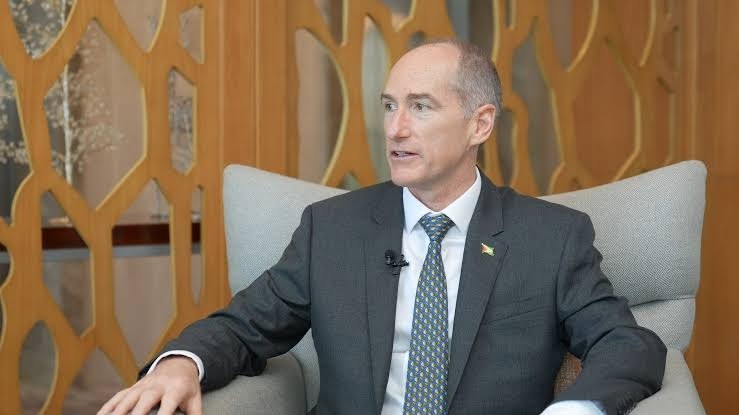
ExxonMobil is looking towards exploration in the northern section of the Stabroek Block once the Guyana-Venezuela border controversy is resolved, with its local President Alistair Routledge expressing confidence in the boundary established by the 1899 Arbitral Award.
Speaking at a press conference at the company’s Ogle headquarters on Tuesday, Routledge said ExxonMobil remains committed to its operations in Guyana and looks forward to accessing areas previously unavailable for exploration.
“We feel very confident … that the territory, the onshore land border is very clear,” he told reporters.
Routledge said resolving the controversy is a matter for sovereign states. However, he explained that the company engages policymakers to provide information about its business and the history of the 1899 arbitration, which the United States helped facilitate.
He also suggested that international partners, including the US, could help both countries move forward following the International Court of Justice’s (ICJ) final ruling.
Reaffirming ExxonMobil’s commitment to Guyana, Routledge said: “We’re here for the long term. You know, we made our commitments to developing the Stabroek Block under the petroleum agreement.”
His comments followed President Dr Irfaan Ali’s assurance that the government would defend every square inch of Guyana’s territory and respect the ICJ’s decision.
Ali, speaking at the commissioning of the Leguan water-treatment plant earlier this week, also highlighted the United States’ stated recognition of the 1899 Arbitral Award as the full, final and complete settlement of the land boundary.
The President’s remarks came after Reuters reported that a senior US official had suggested Guyana consider ceding part of Essequibo to Venezuela.
The Ministry of Foreign Affairs and International Co-operation rejected that suggestion, maintaining that Guyana remains committed to settling the controversy through the ICJ.