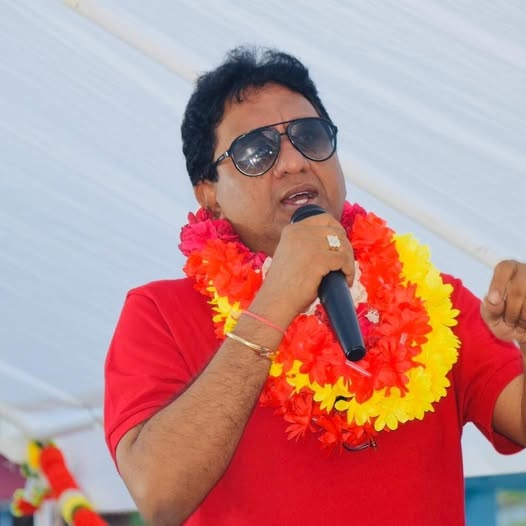


Attorney General and Minister of Legal Affairs, Anil Nandlall, SC, has taken aim at the Guyana Human Rights Association (GHRA), accusing the body of “selective advocacy” and “political bias” following its recent statement criticizing the Constitutional Reform Commission (CRC).
Speaking on his weekly Issues in the News programme, Nandlall described the GHRA as “one of the most mysterious organizations in this part of the world,” noting that it only issues statements every few months, and that those statements are “almost always critical of the PPP/C Government.”
“You can have the worst form of human rights abuse and vulgar violations of the rule of law taking place in the country, and this organization is silent. But once a statement comes out, it’s somehow critical of the government,” the Attorney General said.
He recalled that during the tumultuous post-elections period of 2020, when “certain officials at GECOM, in conspiracy with leaders of APNU and AFC, attempted to derail democracy,” the GHRA “was largely quiet,” despite widespread violations and violence.
According to Nandlall, the Association’s latest statement, titled “Proposed Constitutional Reform Commission Should Not Be Under Political Party Control”, misrepresents both the composition and intent of the current CRC. The AG said the GHRA’s claim that government was handpicking civil society representatives was “entirely false.”
“The nominees from civil society organizations emanate from those organizations themselves, not from the government,” Nandlall clarified. “If you check it sector by sector, this commission may be even more broad-based than the 1999–2001 model.”
He also defended the administration’s decision to review and amend the Constitutional Reform Commission Act to reflect the current composition of Parliament, calling it a matter of “democratic accuracy.”
“I don’t know if the author of this document has comprehension problems,” Nandlall said pointedly. “How would it be reflective of the democratic will of the people if we ignore the new configuration in Parliament?”
The Attorney General maintained that the government remains committed to ensuring that the Commission is balanced and representative of both the opposition and civil society, noting that ten members will come from the National Assembly- five from the government and five from the opposition, and ten from various civil society bodies.
Nandlall further suggested that the GHRA’s pattern of commentary raises questions about whose interests the group truly represents.
“It can’t be the Guyanese population. These people have to be representing some unknown vested interest,” he said.
While acknowledging the GHRA’s historical contributions to human rights work in the 1970s and 80s, Nandlall argued that the organization has “lost its path,” saying its public interventions now lack balance and fairness.
“Whatever I say, I say with the greatest of respect,” he added. “But this organization has become perverse in its selectivity and silence.”
The Constitutional Reform Commission, which the government says mirrors the 1999–2000 structure, is intended to oversee national consultations and propose updates to Guyana’s supreme law. Despite the GHRA’s concerns, Nandlall insisted that the body will operate with full independence and broad-based representation.


