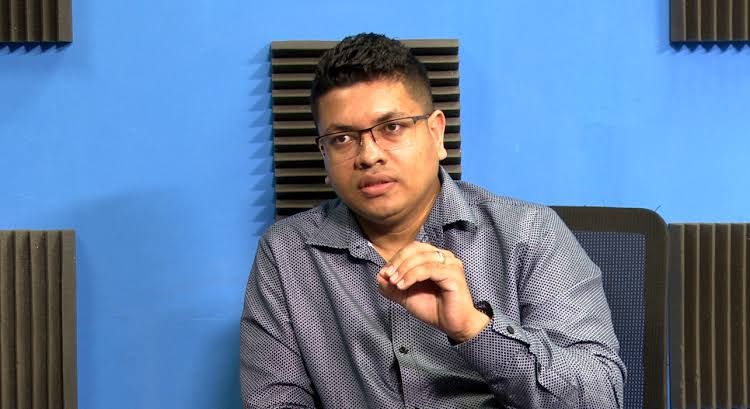


Financial analyst Joel Bhagwandin has slammed the embattled, U.S.-sanctioned businessman and leader of the We Invest in Nationhood (WIN) party, accusing him of launching one of the “lowest” political attacks on President Irfaan Ali over the issue of cash grants. According to Bhagwandin, the WIN leader recently posted a pre-recorded, scripted statement comparing Guyana to several Middle Eastern nations that provide direct cash transfers to their citizens. But Bhagwandin argues that while the WIN leader seems well-versed in the affairs of those countries, he appears to know very little about Guyana’s own fiscal policies, many of which have been in place long before oil was discovered.
He added that this lack of awareness is not surprising, pointing out that the businessman “apparently does business with a particular Middle Eastern country,” the same one at the centre of the gold-smuggling probe in which he now faces serious allegations. Bhagwandin reminded that this is the very country where the WIN leader allegedly smuggled more than $300 billion in gold and evaded taxes amounting to about $191 billion, yet he is now attempting to lecture the President and the PPP/C government about cash grants. Bhagwandin stressed that Guyana, under successive PPP/C administrations, has a long record of direct support to households, which the WIN leader “may not be aware of” because he was allegedly “busy engaged in illicit trading of gold,” resulting in OFAC sanctions and a U.S. court indictment.
To “educate” the WIN leader, Bhagwandin outlined several major cash-transfer measures implemented by the PPP/C over the years. Mortgage Interest Relief (MIR), introduced in 2013 for home loans up to $30M, covers interest costs valued at up to $22.6M over 25 years. The Because We Care cash grant, launched in 2014, halted under APNU, and reinstated in 2021, now stands at $55,000 per child annually. Full subsidy for eight CXC subjects per child was increased in 2025. Annual public assistance continues to be a longstanding direct transfer. A debt write-off for past University of Guyana students was implemented as another form of cash transfer. The GOAL scholarship programme and now free university education also serve as direct transfers. A new-born cash grant of $100,000 was introduced in 2025. A more than $20B electricity subsidy was implemented to keep GPL rates stable after the post-COVID oil-price surge. The reversal of over 200 taxes imposed by the former APNU+AFC government is valued at more than $90B annually. The complete waiver of excise tax on fuel imports is valued at over $60B per year.
Bhagwandin said these measures together amount to more than $500 billion annually in direct transfers to Guyanese households, significantly more than anything suggested by the WIN leader, and long predating oil revenue. He noted that the one-off 2024 cash grant, which the PPP/C has committed to making an annual measure in its 2025–2030 manifesto, will also continue alongside the long list of existing programmes. But he reminded that such transfers must pass through the national budget, at a time when government is heavily focused on preparations for the 2026 estimates.
Bhagwandin argued that such budgeting considerations seem “alien” to the WIN leader, claiming he has shown a “well-established track record” of disregarding laws and compliance rules, which may explain his misunderstanding of fiscal management and public accountability. He also suggested the businessman’s sudden push for parliamentary sittings may be driven more by a desire to escape the consequences of OFAC sanctions than any genuine concern for citizens.
Closing his letter, Bhagwandin maintained that Guyana’s system of direct cash transfers is “robust, institutionalised, and predates oil revenues,” and that the criticisms levelled by the WIN leader are “baseless” and grounded in ignorance of the country’s fiscal policies.


