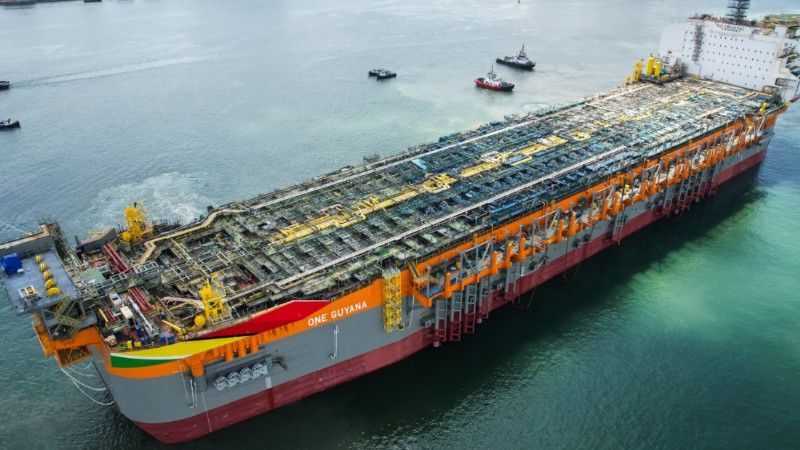


Guyana’s merchandise import bill surged by more than 80 per cent in the first half of 2025, driven almost entirely by the importation of the country’s fourth Floating Production Storage and Offloading (FPSO) vessel, One Guyana, according to the Bank of Guyana’s Half-Year Report.
The value of merchandise imports increased by 81.1 per cent, or US$2,638.8 million, to US$5,894.6 million. This sharp rise was largely attributed to higher imports of capital goods, stemming from the arrival of the One Guyana FPSO in April 2025, valued at US$2,534.096 million.
Capital goods imports rose by US$2,522.1 million to US$3,881.7 million, reflecting the impact of the FPSO import, which was classified under mining machinery for use in the oil and gas sector. Additional increases were recorded in agricultural machinery, building materials and industrial machinery, which rose by US$43.4 million, US$26.3 million and US$16.1 million, respectively. However, imports of transport machinery and other capital goods declined by US$66.1 million and US$11.4 million.
Consumption goods imports also increased, amounting to US$616.6 million, up 24.5 per cent or US$121.3 million compared with the corresponding period in 2024. This rise was due to higher imports across several sub-categories, including other durables, motor cars, food for final consumption, other non-durable goods, beverages and tobacco, other semi-durable goods, and clothing and footwear.
In contrast, imports of intermediate goods edged down slightly by 0.7 per cent, or US$10.1 million, to US$1,385.3 million. This decline was linked to lower import bills for fuel and lubricants, food for intermediate use, and other intermediate goods. These reductions were partly offset by higher imports of parts and accessories, chemicals, and textiles and fabrics.
The report also noted that the average Brent crude oil price fell by 14.6 per cent to US$71.72 per barrel during the period, contributing to the reduced fuel import bill.
Overall, the Bank of Guyana’s data highlights the continued influence of large-scale oil and gas investments on the country’s external trade figures.


