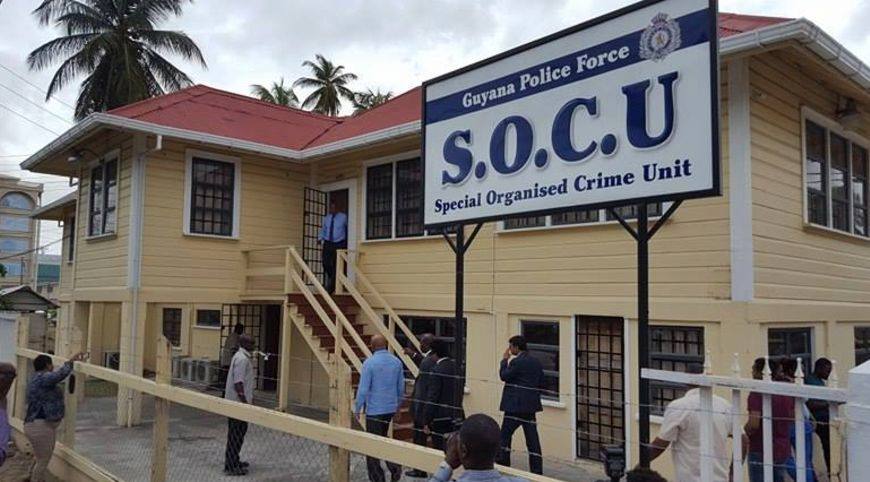


The Full Court has unanimously ruled that the Special Organised Crime Unit (SOCU) has the legal authority to institute and maintain court proceedings under Guyana’s Anti-Money Laundering and Countering the Financing of Terrorism Act (AMLCFT Act), overturning an earlier High Court decision that questioned the agency’s standing.
In a recent judgment, Justices Nigel Niles and Zamilla Ally-Seepaul held that SOCU’s capacity to bring legal actions is sufficiently provided for under the AMLCFT Act (Cap. 10:11), particularly in matters involving the restraint, detention and confiscation of property suspected to be linked to money laundering.
The decision sets aside a ruling by High Court Judge Justice Peter Hugh, who on May 27, 2025, struck out SOCU’s application seeking detention and restraint orders over a large quantity of gold and various sums of foreign and Guyanese currency.
The assets are said to belong to Sebastiao Moura and Gago Gold Inc., and SOCU alleges they are “tainted” and represent proceeds of crime.
In dismissing SOCU’s application earlier this year, Justice Hugh ruled, among other things, that SOCU was not a body corporate under the Companies Act and that the AMLCFT Act did not expressly grant it corporate status, therefore, he found the agency could not institute or maintain legal proceedings in its own name.
That reasoning was rejected by the Full Court following written and oral submissions. Attorney General and Minister of Legal Affairs Anil Nandlall, SC, who appeared for SOCU, told the Full Court that the issue of legal standing was of substantial public importance, warning that the earlier ruling effectively disabled SOCU from carrying out key statutory functions assigned to it by Parliament.
Nandlall argued that SOCU’s ability to approach the courts is built into the AMLCFT framework and that corporate personality under the Companies Act was not a relevant test for a statutory law-enforcement unit operating under a specific legislative mandate.
The Full Court agreed, describing the question as one of public importance that goes to the effective administration of the AML/CFT regime and, if left unresolved, could recur and affect future proceedings.
In its analysis, the Full Court examined provisions including sections 2, 38, 39 and 109A of the AMLCFT Act and concluded that the law assigns SOCU functions that cannot be carried out without recourse to the courts, particularly the “restraining, seizing, detaining and forfeiting” of suspected tainted property.
The judges also found that sections 38 and 109A place SOCU directly within the civil restraint and confiscation framework, and said it would be illogical for Parliament to grant SOCU those powers while denying it the procedural ability to seek court orders.
Based on the statutory provisions and relevant case law, the Full Court concluded SOCU has sufficient legal capacity under the AMLCFT Act to bring civil restraint and confiscation proceedings, and that there is no requirement for the unit to possess corporate personality to do so.
Moura, a Brazilian national with gold mining operations in Guyana, is charged with five counts of money laundering under section 3(1)(c) of the AMLCFT Act.
Those criminal proceedings are ongoing in the Georgetown Magistrates’ Court, and SOCU has maintained that the seized assets are directly tied to the alleged offences.
SOCU was represented by Attorney General Nandlall, SC, along with Shoshanna V. Lall, David Brathwaite, Thalia Thompson and Mohanie Sudama. The respondents were represented by Latchmie Rahamat and Naresh Poonai.

