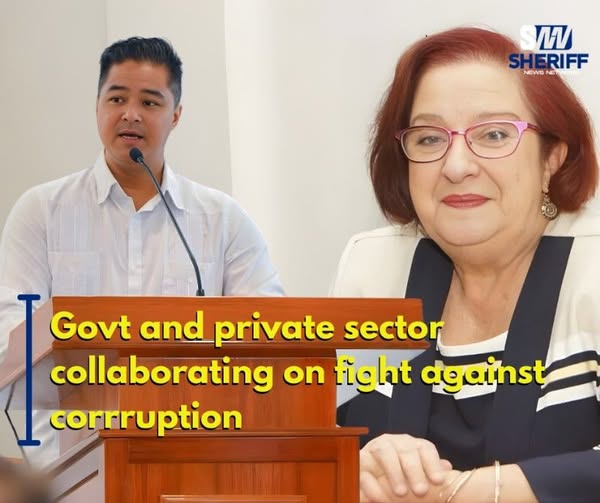


Government officials and private sector representatives today reaffirmed their commitment to strengthening national systems that guard against corruption, during the opening of an Anti-Corruption Roundtable held under the theme “Partnering to build resilient public and private institutions in Guyana’s fight against corruption.”
The forum follows a similar engagement held last year between Government and private sector bodies to examine Guyana’s anti-corruption framework. Today’s session is intended to build on that groundwork by further sensitising stakeholders, reviewing policy and legislative tools, and identifying practical solutions for stronger institutional oversight.
Representing the Private Sector Commission (PSC), Captain Jerry Gouveia Jr. underscored that a strong anti-corruption environment is not only important for public accountability, but also plays a major role in economic competitiveness. He noted that businesses are more confident investing and expanding when they feel assured that systems are transparent and fair. He also acknowledged the presence of regional partners at the event, pointing out that Guyana’s growth is tied to growth within the wider Caribbean, and cannot be pursued in isolation.
Acting Prime Minister and Minister of Governance and Parliamentary Affairs, Gail Teixeira, spoke to the evolution of Guyana’s democratic and administrative systems over the years. She reminded attendees that the country began from a very different baseline compared to nations with centuries-old democratic institutions, and that the progress made has required deliberate reform.
Teixeira highlighted the major constitutional reforms of 1999 to 2001, which led to the establishment of several constitutional and rights-based bodies. She noted that Guyana was among the first in the region to introduce key oversight mechanisms such as the Public Procurement Act and the Parliamentary Oversight Committees, which require ministers and officials to answer directly to the public via Parliament. The Public Procurement Commission, she added, remains another critical constitutional agency tasked with ensuring transparency in the award of state contracts.
Reflecting on earlier challenges, Teixeira pointed out that Guyana once ranked among the poorest countries with a very small budget, and that progress at that time required significant adjustments, particularly during periods of violent crime and limited resources. Today, she said, Guyana has more resources than ever before and is using them to expand infrastructure and strengthen state systems, such as through major projects like the Bharrat Jagdeo Harbour Bridge and continued work on the Lethem road.
Teixeira stressed that every act of corruption directly reduces the funds available for development, noting that resources lost could build schools, roads and other public services. She said oversight systems have improved, citing recent Auditor General reports which show full recovery of overpayments for three consecutive years. The increased level of scrutiny has also required private contractors to uphold higher standards, since reputational damage and accountability measures are now more visible.
She encouraged continued momentum and participation from all stakeholders, emphasising that democracy and transparency cannot be taken for granted. The work of strengthening institutions, she said, is ongoing, requiring continuous training, review and adjustment to ensure systems remain effective.


