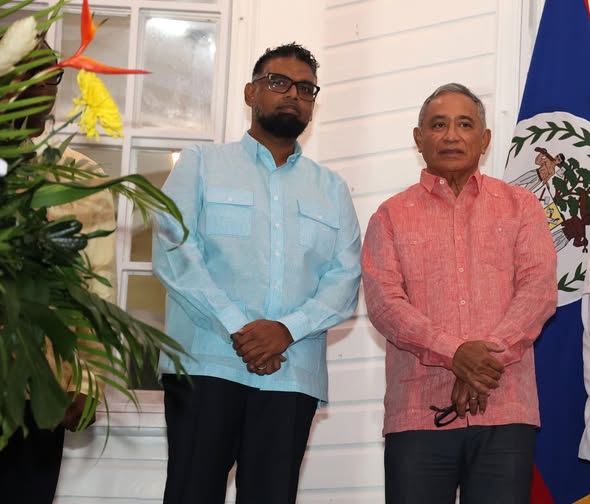


President Dr Irfaan Ali on Monday used his address to the Belize National Assembly to call for expanded cooperation between Guyana and Belize as the two countries prepare to sign several Memoranda of Understanding (MOUs) in areas including education, agriculture, tourism, technology, and security.
The Guyanese leader is in Belize on a three-day State visit, during which he said the longstanding relationship between the two CARICOM states must now translate into deeper economic integration, shared resilience and tangible benefits for citizens.
“It is a great honour to stand before this Assembly in the spirit of friendship and shared purpose that has long united Belize and Guyana,” President Ali said, noting that the visit provided “a valued opportunity to deepen political dialogue [and] expand cooperation across economic, security, cultural, and environmental spheres.”
The Head of State placed strong emphasis on regional food security, arguing that Belize and Guyana must take a leadership role in feeding the Caribbean while pushing back against bureaucratic and artificial trade barriers.
“Belize and Guyana must lead in the food security of this region,” he said, adding, “We must together champion the cause of removing the barriers to trade, especially in food, in this region.”
He stressed that CARICOM’s target to reduce the regional food import bill by 25 per cent by 2030 presents “enormous opportunities” for both countries, particularly through modern agricultural technology, climate-resilient farming and value-added agro-processing. Ali said Guyana stands ready to partner with Belize in adopting new systems and innovations.
The President also framed climate change as the most urgent existential threat facing small states, while rejecting what he described as a charity-based approach to climate financing.
“The solution is not a begging bowl for handouts, or for charity, or for sympathy,” Ali declared. “The problem is real, and we have real assets… the solution must be market-based.”
He highlighted Guyana’s low-carbon development strategy and its approach to monetising forest conservation through carbon credits, arguing that forest-rich countries like Guyana and Belize must ensure the economic value of their ecosystems is returned to their people.
“In Guyana, we have made it clear that our forests are worth more standing than being felled,” he said.
Sr. Ali reaffirmed both countries’ commitment to democratic governance, regional integration and the peaceful settlement of disputes, noting that CARICOM has remained “intact, resilient and relevant” for more than 50 years.
“Regional cooperation is not a surrender of sovereignty. It is a reinforcement of that sovereignty,” he told legislators.
He also underscored the need for coordinated regional responses to transnational crime, climate risks, energy insecurity and economic shocks, arguing that “transnational problems demand transnational solutions.”
Turning to economic growth, the Guyanese President urged private-sector actors in both countries to actively pursue cross-border partnerships in capital, talent, land, technology, and markets, assuring them that both governments are aligned in supporting private enterprise.
“I assure you… that the prosperity of Guyana will lead to the prosperity of Belize and the prosperity of this region,” he said.
Guyana and Belize are expected to formalise cooperation through several MOUs during the State visit, aimed at strengthening institutional ties and advancing shared development goals across key sectors.


