Hinterland growing faster than the coast as population shifts inland
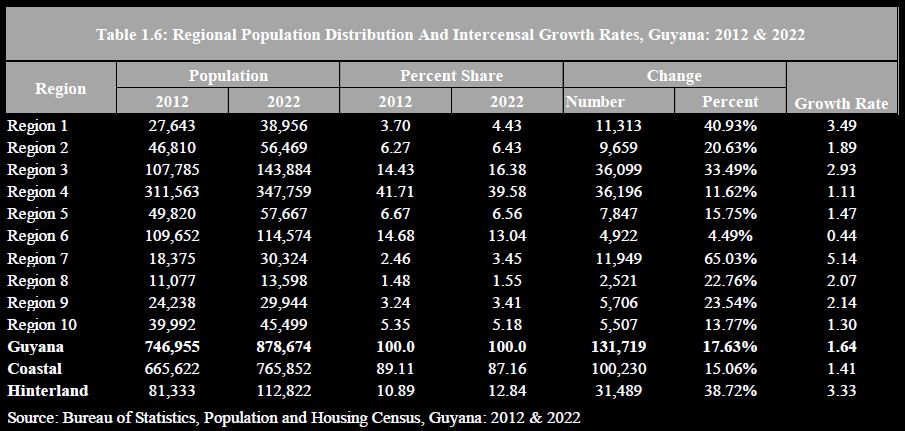


Guyana’s hinterland regions are recording significantly faster population growth than the coastal belt, even as the majority of the country’s population continues to reside along the coast, according to the Guyana National Population and Housing Census 2022 – Preliminary Report .
The census shows that while the Coastland remains home to 87.16 per cent of the population, its share declined from 89.11 per cent in 2012, as population growth in the Hinterland accelerated sharply over the ten-year intercensal period.
Between 2012 and 2022, the combined hinterland regions recorded an average annual growth rate of 3.33 per cent, more than double the 1.41 per cent growth rate recorded for the coastal regions. As a result, the hinterland’s share of the national population increased from 10.89 per cent in 2012 to 12.84 per cent in 2022.
Region Seven (Cuyuni-Mazaruni) recorded the highest population growth rate in the country, expanding at 5.14 per cent per annum, with its population rising from 18,375 in 2012 to 30,324 in 2022. Region One (Barima-Waini) followed with a growth rate of 3.49 per cent, increasing its population from 27,643 to 38,956 over the same period.
Other hinterland regions also recorded strong growth. Region Nine (Upper Takutu–Upper Essequibo) grew at 2.14 per cent, while Region Eight (Potaro-Siparuni) recorded an annual growth rate of 2.07 per cent. Despite these increases, Region Eight remains the least populous region, with 13,598 persons counted in 2022.
On the Coastland, population growth was more moderate. Region Three (Essequibo Islands-West Demerara) recorded the highest coastal growth rate at 2.93 per cent, increasing from 107,785 persons in 2012 to 143,884 in 2022. Region Four (Demerara-Mahaica), which remains the most populous region, grew at 1.11 per cent, moving from 311,563 to 347,759 persons.
Region Six (East Berbice-Corentyne) recorded the slowest population growth in the country, expanding by just 0.44 per cent per annum, while Region Five (Mahaica-Berbice) and Region Two (Pomeroon-Supenaam) recorded growth rates of 1.47 per cent and 1.89 per cent, respectively.
The Bureau of Statistics noted that all ten administrative regions recorded positive population growth during the intercensal period, marking a significant shift from earlier decades when population decline and outward migration were more pronounced.
According to the report, the faster rate of population growth in the hinterland has contributed to a gradual rebalancing of Guyana’s population distribution, even though the coast continues to dominate in absolute numbers .


