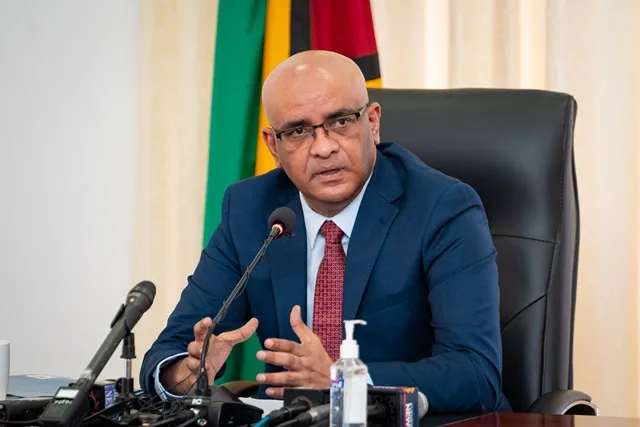


The General Secretary of the People’s Progressive Party (PPP), Dr. Bharrat Jagdeo, forcefully rejected comparisons made by the Guyana Human Rights Association (GHRA) between the Dr. Irfaan Ali-led administration and the autocratic rule of former President Forbes Burnham, calling the claims “extremist” and “offensive.”
At a press conference on Thursday, Jagdeo slammed a June 23rd GHRA statement that drew parallels between PPP governance and the authoritarian tactics used under Burnham’s People’s National Congress (PNC) government, which ruled from 1964 to 1985.
“They are comparing us with Burnham now,” Jagdeo said. “Saying that Burnham had the Party (PNCR) flag flying over the high court of Guyana; two, that Burnham was involved with control of the Police Force, control of the judiciary; Burnham rigged elections to stay in power, and that the PPP is like the Burnham. This is the GHRA.”
Jagdeo went further, accusing GHRA’s current leadership of being complicit during Burnham’s rule. “They were complicit with Burnham in taking away our freedoms, rigging elections, controlling the judiciary, and using the Police Force and the Army as coercive arms of the PNC, not even of the state.”
Jagdeo strongly denied these claims. “We have never sought to rig elections or steal people’s votes… we don’t direct the judiciary. We have put back an independent judiciary in place [….] we don’t direct the Police Force.”
“We in Guyana now, this is an extraordinarily free country by any metric,” he added. “You look at social media; you look at freedom of the Press in Guyana; you look at the independence of the judiciary. These are the important elements of any free country and no one can say that there is any attempt by the government to take away people’s freedoms.”
Jagdeo emphasised that the PPP/C would not allow its record to be distorted and will vigorously defend its record against naysayers.
Notably, the 155-page report from the International Commission of Inquiry (CoI) into the 1980 assassination of historian Dr. Walter Rodney paints a stark picture of the Forbes Burnham-led People’s National Congress (PNC) regime, detailing decades of authoritarian rule and economic decline that left Guyana among the poorest countries in the Western Hemisphere by the early 1990s.
The CoI linked the Burnham administration to a doctrine of party paramountcy, in which the ruling PNC wielded control over the Guyana Police Force (GPF), the Guyana Defence Force (GDF), and the judiciary to suppress dissent. On page 56, the report notes, “Extra judicial killings had gotten worst under the Burnham administration.”
The report also described a climate of political violence. Page 46 documented that the PNC maintained a “good squad of thugs who would disrupt political meetings organised by opposition groups, even in the face of police,” with tactics ranging from damaging sound systems to physically assaulting opposition speakers and supporters.
These findings cite George Danns’ book Domination and Power in Guyana: A Study of the Police in a Third World Context.
Quoting activist Tacuma Ogunseye, the CoI stated Burnham was willing “to do anything to maintain power and that included violence and death.”
Page 39 of the report identified the House of Israel—a militant religious group—with ties to the PNC’s youth arm (the Youth Socialist Movement), and described how its members carried arms and acted with impunity: “They felt in no way concerned that they would be arrested.”
The report detailed how these groups routinely intimidated and assaulted civilians in plain view of law enforcement without consequences due to the political protection they received.
Labour unions were also co-opted. The report named several unions, including the Guyana Labour Union and the Guyana Teachers’ Union, as being aligned with the PNC. Those who resisted were “ruthlessly attacked,” and the report noted the regime’s principle that “the PNC came before unions.”
Beyond political repression, the CoI report and subsequent economic reviews chronicled the country’s financial freefall under Burnham’s leadership.
By 1992, Guyana’s debt had ballooned to over 900% of its GDP, and 153% of government revenue was being allocated to servicing debt. In contrast, by 2024, Guyana’s debt-to-GDP ratio had dropped to 24.3%, one of the lowest globally.
The 1989 McIntyre Report, led by former CARICOM Secretary General Alister McIntyre, ranked Guyana as poorer than Haiti at the time, making it the poorest country in the Western Hemisphere. The report noted that 87% of Guyanese were living below the poverty line by 1990, and highlighted mass emigration, with around 1,000 citizens leaving each month.
Economic mismanagement under the PNC included widespread inflation, which reached 50% annually, and unemployment affecting approximately 40% of the workforce. By 1980, average incomes had halved, and the population faced hunger, malnutrition, homelessness, and vagrancy. Many spent their days searching for basic necessities.
The report attributed this decline to state overreach in the economy, which stifled investment and private sector growth, thereby accelerating the departure of many of Guyana’s most skilled citizens.


