President Ali outlines plans for agro expansion- eyes citrus, coconut, coffee and juice plant in Skeldon
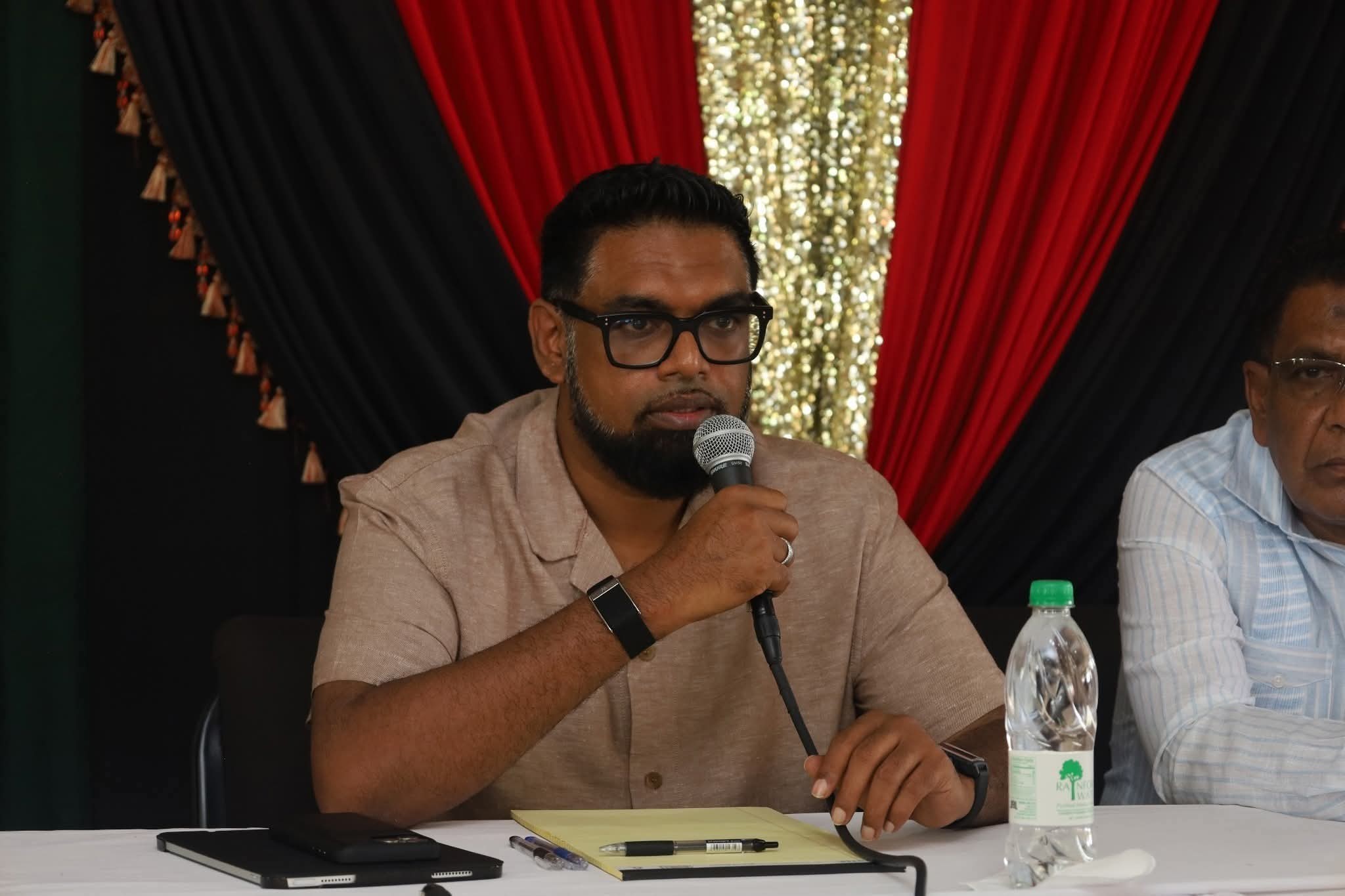


President Dr. Irfaan Ali today told farmers and other stakeholders that his government plans to expand and diversify Guyana’s agriculture sector, with a focus on citrus, coconuts, coffee, dragon fruit and the possible return of a sugar factory.
Speaking at a meeting with farmers, the Head of State stressed that while sugar will remain important, diversification and large-scale modern production are key aspects for a “sustainable operation.”
“We are fully aware that the process of mechanisation and system improvement must continue at an even more rapid pace for this sector to realise greater potential,” President Ali said.
He revealed that Guyana has between 8,000 to 12,000 acres of land under the control of private cane farmers, much of which could be directed into new ventures. “One farmer has 400 acres of citrus,” Ali noted, adding that government now has to decide “what we will do and how we will do it efficiently and aggressively, that is profitable and that allows technology to be incorporated.”
The President disclosed that the government is already working with specialists from Roraima, Brazil, as well as a team from the Dominican Republic, to bring technology and expertise into the local sector. Soil sampling and lab testing of farmers’ lands are expected to begin within days to identify the most suitable crops.
“In less than a week, all the soil samples will be taken and a full lab analysis done,” Ali explained. “We’re doing everything in a scientific way. All the information will be placed on a website so farmers and investors can see it.”
Ali further revealed that Demerara Distillers Limited (DDL) has signalled willingness to invest in a juice plant in Skeldon, provided farmers commit to citrus and other fruit production. “They said they can have that juice plant fully operational between 8 and 12 months,” the President announced.
On sugar, he disclosed that the government has already received proposals for the re-establishment of a factory. However, this would require agreement with farmers on long-term pricing. “These investments require a long-term pricing mechanism because investors have to justify their investment,” he cautioned, adding that infrastructure costs could run into billions of dollars.
Beyond citrus and sugar, coconut and coffee are also being explored as viable large-scale options. Ali pointed to 3,000 acres of new coconut plantations already in Region Two, while Roraima’s experience shows coffee can reach production within two years.
The President also cited opportunities in large-scale dragon fruit cultivation, but stressed that the approach must be multi-pronged.
To drive the process, the government plans to bring together cane farmers, the Ministry of Agriculture, private sector players such as DDL and Banks DIH, and international partners. Within 14 days, a joint investment meeting is expected to be held once soil mapping and analysis are completed.
“Our role is to provide the enabling environment, the right incentives, and investment in drainage, irrigation and infrastructure,” Ali said. “But those investments must be linked to production and productivity. We can’t have land lying idle. We must maximise the use of our factors of production in building the economy, expanding business opportunities and creating jobs.”


