President Ali rejects EU claim of incumbency advantage to EU election report, reminds 2025 elections were “peaceful, efficient and professional”
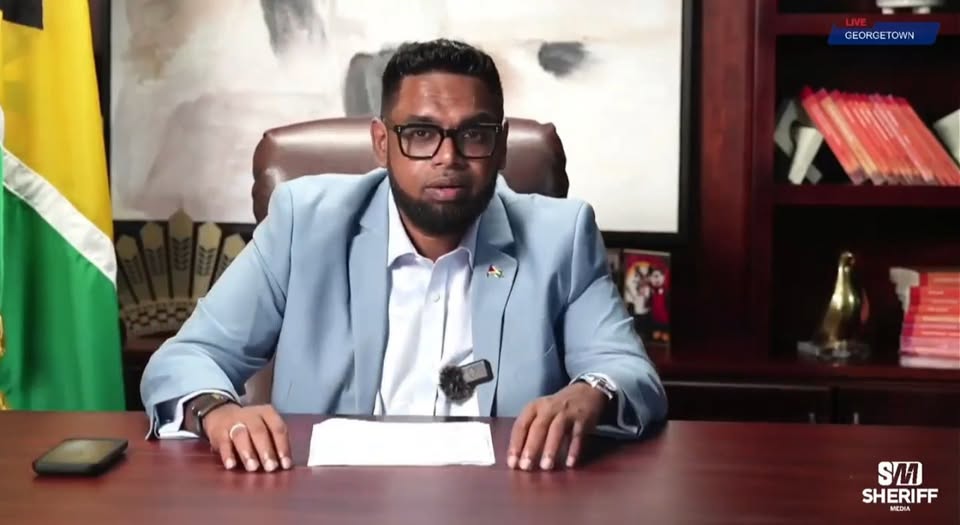


President Irfaan Ali on Wednesday night addressed what he described as several matters of national importance, starting with the recently released European Union (EU) Election Observation Mission’s final report on Guyana’s 2025 General and Regional Elections.
The President said that while all observer groups found the elections to be free and fair, and were “very complementary in the management of our elections”, the EU’s report raised issues.
He stressed that for any functioning democracy, the Executive, Judiciary and Legislature must uphold the rule of law, fairness, equity and justice. He noted that public feedback prompted him to comment directly on aspects of the EU’s findings.
According to President Ali, the EU report itself confirms that election day was “peaceful, calm and orderly,” with voting, counting and tabulation described as “efficiently and professionally” administered. He highlighted that these are three of the most critical components of a free and fair election.
The report also noted the strong participation of women, with 87% of election day staff and 81% of presiding officers being female.
On the pre-election environment, the President pointed to the EU’s acknowledgement of major improvements in electoral laws and procedures. He reminded that Guyana’s 2022 electoral reforms consolidated multiple laws and introduced “over 100 technical improvements,” including tighter recount procedures, increased penalties for electoral offenses and real-time online publication of Statements of Poll (SOPs).
He said the EU further credited GECOM for efficient logistical operations, professional training of polling staff, and stronger voter information outreach through hotline services and multimedia tools. All political parties and observers, both domestic and international, were accredited and present at polling stations.
However, President Ali strongly objected to the report’s suggestion of an “uneven playing field” and “undue advantage by incumbency.” He described that conclusion as “ridiculous” and “not based on any facts,” arguing that the government’s visible performance, new schools, hospitals, health centres, roads, rice farmer subsidies and expanded social programmes, was part of its 2020–2025 manifesto and annual budgets, not special election-related activities.
“That’s not an incumbency advantage. That is a commitment that a government made… and delivered on,” he said. “What kind of system will deny an incumbent to celebrate its success?”
The President said the EU’s analysis failed to consider that every social programme implemented near the elections had already been announced in the national budgets. He added that concerns about party calls to citizens were not unique to government, noting “persons receive calls from all political parties.”
On campaign finance regulation, he reminded that Guyana is already advancing legislative modernisation through the ongoing Constitutional Reform Commission, a process he said the EU report failed to mention.
He also pushed back on claims of media bias favouring the ruling party, stating that independent assessments showed some private media houses carried “80% negative” and “90% negative” coverage against the PPP/C.
Regarding concerns about the voters list, the President said the report should have referenced the court ruling that guides the removal of deceased persons. He pointed out that the elections were declared free and fair, meaning only registered voters participated.
President Ali agreed, however, with the EU’s observation that 59% of polling stations lacked independent access for persons living with disabilities. He said government is already addressing this through a new building code to ensure public facilities accommodate all citizens.
Reaffirming his government’s commitment to democracy, the rule of law and continuous improvement, the President said, “We welcome every suggestion,” but insisted that some sections of the report were “subjective, partisan, and completely biased.”
He thanked the EU Election Observation Mission for its work but urged the body to “re-evaluate where some narrative comes from” and strengthen future reports to ensure completeness and fairness.
“We look forward to continuing our work with the European Union… as we build a stronger and more resilient electoral system here in Guyana,” he said


