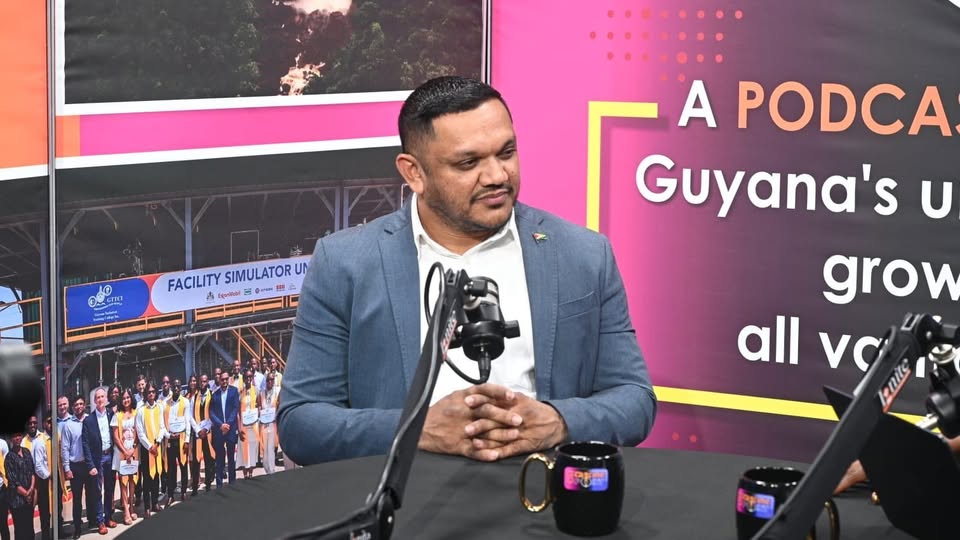


Guyana’s transformation into the world’s fastest-growing economy has not been left to chance but is the product of deliberate leadership and policies, particularly in the oil and gas sector.
This was the central message delivered by Minister of Natural Resources Vickram Bharrat during a recent appearance on the Starting Point podcast, where he credited the government’s vision for shaping a modern Guyana that places its people at the heart of development.
Bharrat emphasised that President Dr Irfaan Ali, Prime Minister Brigadier (ret’d) Mark Phillips, and Vice President Dr Bharrat Jagdeo have provided the decisive leadership needed to manage the petroleum sector responsibly and ensure broad-based national benefits.
“What we have in Guyana is decisive, strong, visionary leadership by the president, prime minister, and vice president,” he remarked. “It calls for quality and bold leadership. And if you look at countries where there are strong leaders—leaders who are not afraid to make decisions in the interest of their country and people—you find that those are the countries that stand out, as Guyana is right now in the world.”
The minister made clear that Guyana’s economic success has been the result of sound management and proactive policies. “This didn’t happen because of the passage of time, mistake, or incident. It happened because of the strong leadership… because we have managed the economy so well, because we have managed the different sectors so well and used the revenues from the sectors to ensure that we build out a new modern Guyana,” Bharrat explained.
A central plank of this management has been the Local Content Act, passed in December 2021, which obligates oil companies and subcontractors to prioritise Guyanese goods, services, and labour. Bharrat described the law as one of the government’s most important achievements in the past five years, ensuring that citizens are not bystanders but active participants in the petroleum industry.
As a direct result, approximately 14,000 Guyanese now benefit from employment and opportunities in oil and gas. More than 7,000 are trained and employed in technical and direct roles, while another 7,000 work in supporting sectors such as logistics, catering, transportation, accommodation, administration, and maintenance.
Beyond job creation, the Act has fostered partnerships between international oil companies and local businesses, enabling technology transfer and skill-building for the local workforce.
The legislation also introduced the Local Content Register, a government-managed database that lists Guyanese nationals and companies qualified to supply goods and services.
This mechanism has given local businesses stronger negotiating power with multinational oil operators, a critical step in ensuring the wealth generated from Guyana’s oil reserves translates into national development.
Bharrat contrasted Guyana’s experience with that of other oil-producing nations where international companies often dominate supply chains, excluding local people.
“When international oil companies come to that country, they usually bring their suppliers with them. They build their own ecosystem around them to provide them with goods and services. In many countries, this is what happens, and the locals are left on the outside as bystanders,” he said, noting that Guyana’s legislation was specifically designed to avoid such outcomes.
The government has committed to continuously strengthening the Act, including expanding the number of mandated categories for local participation. This, according to Bharrat, is essential to sustaining momentum and ensuring inclusive prosperity.
Guyana’s oil industry continues to grow at pace, led by ExxonMobil and partners Hess and CNOOC, which hold stakes in the prolific Stabroek Block.
The discoveries there have placed the small South American nation firmly on the global energy map. For Bharrat, however, the country’s success lies not just in its oil reserves but in the policies and leadership that have ensured the resources serve the people.


