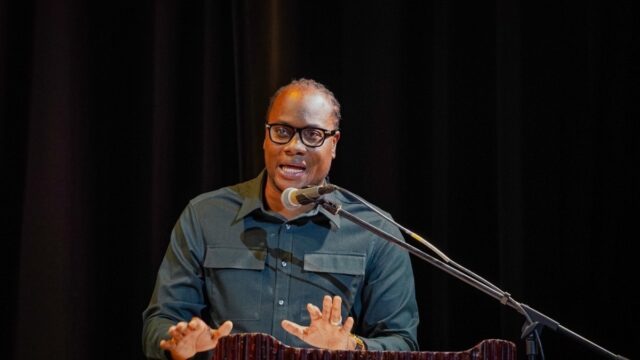

Attorney General and Minister of Legal Affairs, Anil Nandlall, SC, says this year’s top CSEC results show that students from rural and outlying communities are increasingly competing with, and outperforming, students from Guyana’s traditional top urban schools.
Speaking on his weekly programme, Issues in the News, Nandlall pointed to the performance of the top CSEC student from Tagore Memorial Secondary School in Berbice, who wrote 27 subjects and secured 26 Grade Ones and one Grade Two.
He described the results as remarkable, noting that Guyana has consistently produced top-performing students at the Caribbean examination level.
“What I think is most significant is where these students are drawn from,” Nandlall said, as he reflected on how top academic performances were once concentrated mainly among a few Georgetown schools.
The Attorney General said that when he attended secondary school in the 1980s, excellent results were usually associated with institutions such as Queen’s College, The Bishops’ High School and St. Stanislaus College. He said students from rural schools were not generally seen producing the kind of national and regional results now being recorded.
Nandlall argued that the difference today is the more equitable distribution of educational resources across Guyana.
“Bright children are right across Guyana and not in one or two selected or selective schools,” he said.
He said schools in rural areas previously suffered because resources were skewed toward urban centres and a small group of established schools. According to Nandlall, that imbalance limited opportunities for children outside Georgetown.
The Attorney General said the rise of schools such as Tagore Memorial, Anna Regina Multilateral, Leonora Secondary, Annandale Secondary and Rosignol Secondary shows that academic excellence is no longer confined to the capital city.
He said it would have been “unthinkable” decades ago for a student from Tagore Memorial to top Guyana, and possibly the Caribbean, at CSEC.
Nandlall said the results are not accidental, but the outcome of “deliberate, programmatic planning and investment” aimed at giving every child, regardless of location, a fair chance to pursue their dreams.
“These results that you are seeing here is as a result of deliberate, programmatic planning and investment,” he said.
While acknowledging that there is still work to be done, particularly in some subject areas, Nandlall said the current spread of high performers marks a major shift from the education system of earlier decades.
He also said Guyana has moved from a period when some children were denied secondary school placement because there were not enough spaces, to a system of universal secondary education.
According to Nandlall, the improved results from rural and outlying schools reflect long-term investment in education and a policy approach focused on giving children equal access to quality learning opportunities.
“We are achieving what we have set out to achieve,” he said, adding that the aim is to ensure children have equal access to high-quality education.
08:59