
Guyana on Friday formally asked the International Court of Justice (ICJ) to declare that the 1899 Arbitral Award remains valid and binding, while urging the court to order Venezuela to withdraw from any part of Guyana’s territory and repeal all measures aimed at annexing the Essequibo region.
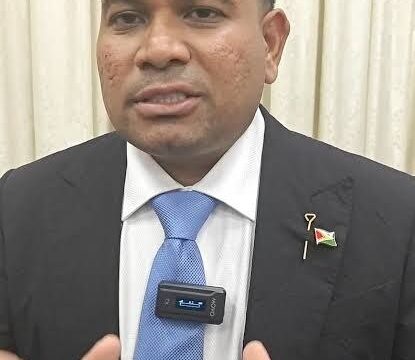
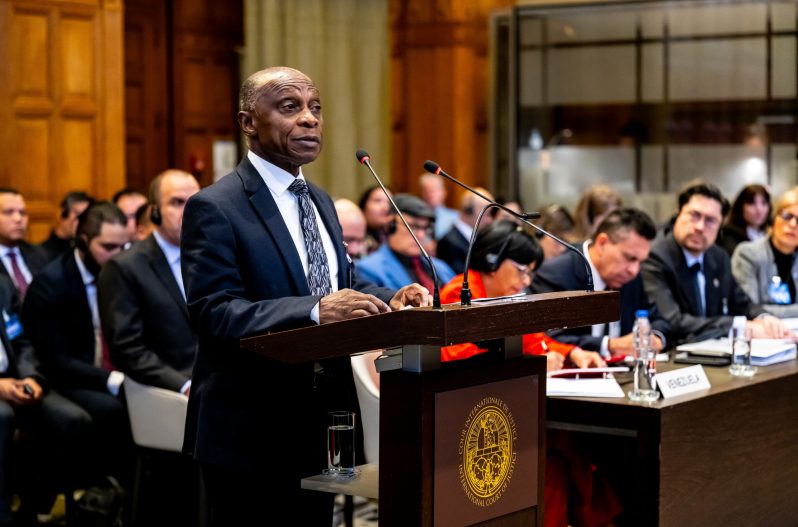
During public hearings in the case concerning the Arbitral Award of 3 October 1899, Guyana’s former Foreign Affairs Minister and Agent before the court, Carl Greenidge, outlined the final reliefs being sought by Guyana against Venezuela.
“In accordance with Article 49 four and article 62 of the rules of court… the Cooperative Republic of Guyana respectfully requests the International Court of Justice to adjudge and declare, one, that the 1899 award is valid and binding upon Guyana and Venezuela,” Greenidge told the court.
He said Guyana is asking the ICJ to confirm that “the boundary established by that award and the 1905 agreement is the boundary between Guyana and Venezuela.”
Greenidge further asked the court to declare that Guyana “enjoys full sovereignty over the territory between the Essequibo River and the boundary established by the 1899 Award and the 1905 agreement,” while Venezuela is obligated to respect Guyana’s territorial integrity.
Guyana also argued that Venezuela breached provisional measures previously issued by the World Court.
According to Greenidge, Guyana is seeking a declaration that Venezuela “has failed to comply with the obligations set out in the orders of 1 December 2023, and 1 May 2025.”
As part of the remedies requested, Guyana asked the ICJ to order Venezuela to “withdraw from any part of Guyana’s territory as defined under the award, including the part of Ankoko island that the award attributed to Guyana.”
Greenidge said Guyana is also seeking orders preventing Venezuela from “asserting or purporting to exercise sovereignty over any part of Guyana’s territory” or taking actions that violate Guyana’s sovereignty.
He further urged the court to compel Venezuela to revoke all laws, decrees and measures intended to annex or administer Guyanese territory.
Among the specific actions Guyana wants reversed are legislation extending Venezuela’s “legislative, executive and judicial jurisdiction” into the Essequibo, along with the dissolution of bodies such as the “High Commission for the Defense of Guyana Esequiba.”
Guyana is additionally asking the ICJ to order Venezuela to terminate “the social care plan for the population of Guyana Esequiba,” end any census activities in the territory, and stop “all military activities conducted in furtherance of Venezuela’s attempt to exercise sovereignty over, annex, administer or control any part of Guyana’s territory.”
Greenidge also asked the court to direct Venezuela to refrain from publicly teaching that the 1899 award was fraudulent or that Venezuela was wrongly deprived of the Essequibo region.
He said Guyana wants Venezuela to “withdraw from all public institutions and facilities, revoke and destroy any map depicting any part of Guyana’s territory as defined by the award, as part of Venezuela.”
The hearings at the Peace Palace in The Hague form part of the merits phase of the decades-long border controversy between the two South American neighbours. Guyana is asking the ICJ to uphold the validity of the 1899 Arbitral Award, while Venezuela continues to reject the court’s jurisdiction and insists the matter should be settled through negotiations.