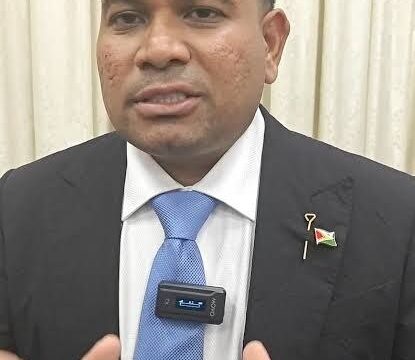


Guyana’s Attorney General and Minister of Legal Affairs, Anil Nandlall, on Friday told the International Court of Justice (ICJ) that Venezuela’s territorial claim has “blighted, bedeviled and burdened” Guyana throughout its existence as an independent nation.
Delivering Guyana’s final presentation during the third day of public hearings in the case concerning the Arbitral Award of October 3, 1899, Nandlall said the decades-long controversy carries an “existential quality” for Guyana and its people.
“For more than 60 years, Venezuela has laid claim to more than 70% of Guyana’s sovereign territory,” Nandlall told the court.He added: “Venezuela’s claim has blighted, bedeviled and burdened Guyana for the entirety of its life as a sovereign state.” According to the Attorney General, the impact of the controversy on Guyana’s development, security and prosperity cannot be overstated. “The loss of the territory claimed by Venezuela would eviscerate Guyana. Indeed, the country as we know it would cease to exist,” he said.
Nandlall stressed that despite the high stakes involved, Guyana has remained firmly committed to resolving the matter through international law and the judicial process.
“As Attorney General of Guyana, I can personally attest to Guyana’s profound commitment to the rule of international law,” he said, describing respect for international law as “both an article of faith and a source of national pride.”
The Attorney General said Guyana entered the case before the ICJ with confidence in the validity of the 1899 Arbitral Award, the United Nations Secretary General’s decision to refer the matter to the court, and the court’s impartiality.
“Since Guyana filed its application eight years ago, these proceedings have vindicated and reinforced Guyana’s confidence in each of those things,” he said.
Nandlall also accused Venezuela of repeatedly trying to prevent the court from ruling on the substantive issues in the case.
“Since the start of these proceedings, Venezuela has trained every sinew to avoid the court delivering a judgment on the merits of Guyana’s application,” he told the judges.
He argued that Venezuela’s objections regarding the Geneva Agreement have already been addressed by the court in its earlier rulings on jurisdiction and admissibility.
According to Nandlall, Venezuela is reluctant to have the merits determined because it “has no good answer to Guyana’s case.”
He said Guyana has demonstrated that Venezuela was neither deceived nor forced into signing the 1897 Treaty of Washington, which paved the way for international arbitration of the boundary dispute.
“The award was and remains valid and binding on the parties,” Nandlall stated.
“In the words of the 1897 treaty, the award constitutes the full perfect and final settlement of the boundary between Venezuela and Guyana.”