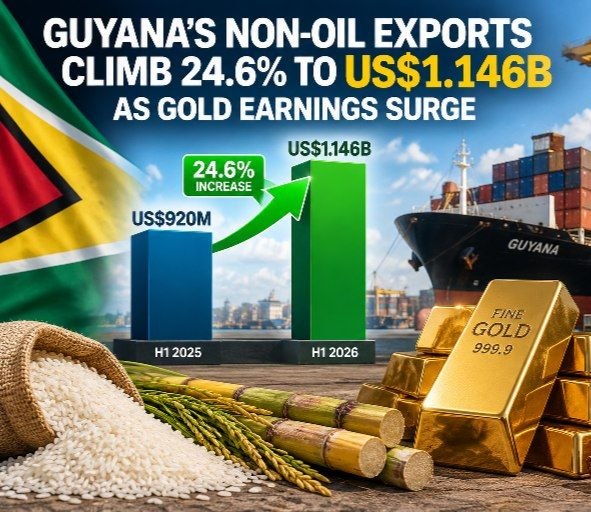
Guyana’s non-oil exports recorded strong growth during the first half of 2026, climbing by 24.6 per cent to US$1.146 billion, with gold accounting for the bulk of the increase, according to the Ministry of Finance’s Mid-Year Report.
The performance represents an increase from approximately US$920 million in non-oil export earnings during the corresponding period last year.
“Non-oil exports also fared well, increasing by 24.6 percent to US$1,146 million, when compared with the first half of 2025,” the report stated.
Gold was the principal contributor to the increase, with export earnings from the precious metal rising by US$269.8 million to US$826.2 million during the first six months of the year.
The Ministry attributed the increase in gold export earnings to favourable prices on the international market. Gold prices averaged US$4,694.20 per troy ounce during the first half of 2026, representing a 52.5 per cent increase compared with the corresponding period last year. The report noted that prices had climbed above US$5,000 per troy ounce in January amid heightened global uncertainty and increased demand for safe-haven assets.
Gold accounted for 5.1 per cent of Guyana’s total exports during the first half and remained the country’s leading non-oil export.
The Ministry noted that the higher gold prices could continue to provide benefits to the country’s non-oil exports, trade balance and royalty earnings. However, it cautioned that a decline in international prices could reduce those gains.
Other traditional exports also recorded increases during the review period, although on a much smaller scale.
Sugar export earnings increased by US$6.6 million, while earnings from bauxite rose by US$0.9 million compared with the first half of 2025.
Rice, meanwhile, remains the second-largest contributor to Guyana’s non-oil exports, but the report identified declining world market prices as a concern.
Average rice prices during the first six months of 2026 were lower than during the corresponding period last year. Earlier in the report, the Ministry said rice prices averaged US$422.50 per metric tonne, representing a 2.7 per cent decline, which it attributed to global oversupply.
The Government has continued providing assistance to rice farmers to support domestic production and offset rising production costs. Farmers cultivating 50 acres or less received $15,000 per acre, while those with more than 50 acres received $10,000 per acre.
Oil still dominates exports
Despite the increase in non-oil exports, petroleum continued to dominate Guyana’s overseas earnings.
Total export earnings surged by 76.4 per cent to US$16.2 billion during the first half of 2026, with crude oil earnings alone reaching US$15.054 billion, an increase of 82.1 per cent.
The report attributed the increase in oil earnings to a combination of higher world market prices and a 40 per cent expansion in export volumes.
Oil accounted for 92.9 per cent of total exports during the first six months of the year, underscoring the size of the petroleum industry relative to Guyana’s other export sectors.
The rise in exports also contributed to a sharp improvement in Guyana’s merchandise trade position.
The merchandise trade surplus increased by 255.6 per cent to US$11.680 billion, while the country’s current account recorded a surplus of US$3.340 billion, more than double the surplus recorded during the corresponding period in 2025.
At the same time, import payments declined by 23.4 per cent to US$4.520 billion, largely because no new Floating Production, Storage and Offloading vessel arrived in Guyana during the first half of 2026, unlike the corresponding period in 2025 when the One Guyana FPSO arrived.
While oil remains overwhelmingly responsible for Guyana’s export earnings, the Mid-Year Report shows that the country’s non-oil export base also recorded significant growth during the first half of the year, led primarily by the strong performance of gold.