
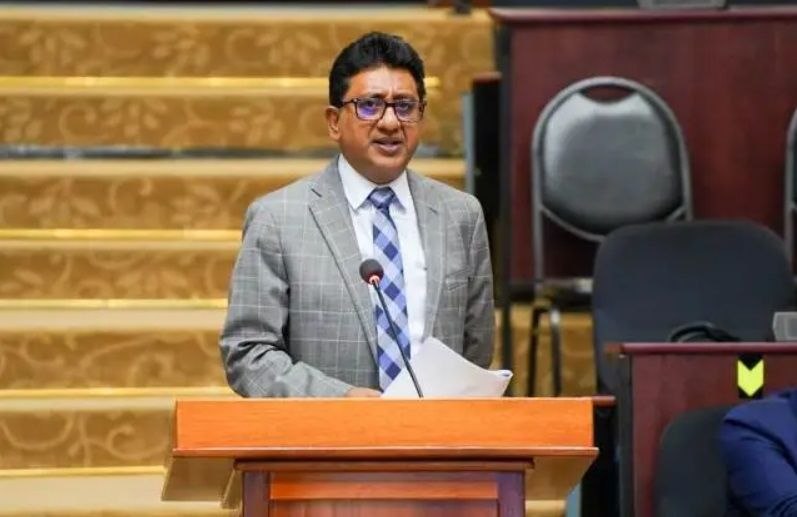
The courts should prepare for more applications to freeze bank accounts, detain property and confiscate assets linked to criminal activity, Attorney General and Minister of Legal Affairs Anil Nandlall has said.
Speaking on his weekly programme, Issues in the News, Nandlall said judges, magistrates and prosecutors must be prepared for a stronger emphasis on pursuing the financial proceeds of crime.
He disclosed that anti-money laundering and countering the financing of terrorism legislation currently being drafted places significant emphasis on asset forfeiture and the recovery of criminal proceeds.
Nandlall said the approach reflects a wider shift in law enforcement towards tracing money and targeting the wealth accumulated by criminal organisations.
“Repeated applications will now be made to the various courts across the judicial spectrum for orders such as freezing orders to freeze bank accounts, detention orders to detain properties, as well as forfeiture orders to confiscate properties that are implicated in or are considered proceeds of crime and criminality,” he said.
The Attorney General said prosecutors are already receiving training to handle this work, while judicial officers must be prepared to interpret and apply the relevant legislation.
“The prosecutors have to be trained to present these types of evidence, and likewise the courts have to be attuned to this new dispensation,” he said.
His comments followed the recent INTERPOL Regional Conference of the Americas in Guyana, where discussions highlighted the growing connection between drug trafficking, illicit mining and the movement of criminal proceeds.
According to the AG, law enforcement agencies must look beyond intercepting drugs and other illegal commodities to identify the assets and financial networks supporting criminal enterprises.
However, Nandlall stressed that legislation alone would not be enough. Effective investigations would require greater coordination among the police, the Customs Anti-Narcotic Unit, the Guyana Revenue Authority, the Financial Intelligence Unit, the Special Organised Crime Unit and the Guyana Geology and Mines Commission.
These agencies, he said, need qualified personnel capable of conducting forensic examinations, analysing financial transactions and scrutinising large volumes of financial records.
He also emphasised the need for the Financial Intelligence Unit to work with overseas counterparts and international agencies to support investigations involving money moving across borders.
Nandlall argued that investigators, prosecutors and courts all have distinct responsibilities in responding to increasingly sophisticated criminal activity.
He acknowledged that the statutory provisions associated with this approach can be punitive and may be viewed as oppressive, but maintained that they form part of the emerging framework for combating crime.
Criminal organisations, he warned, are investing heavily in technology and equipment and exploiting new innovations. Authorities must develop the expertise and efficiency to respond.
“Unless, on the other side of the law, these multiple agencies respond with commensurate sophistication and efficiency, then the criminals will continue to win the battle,” Nandlall said.