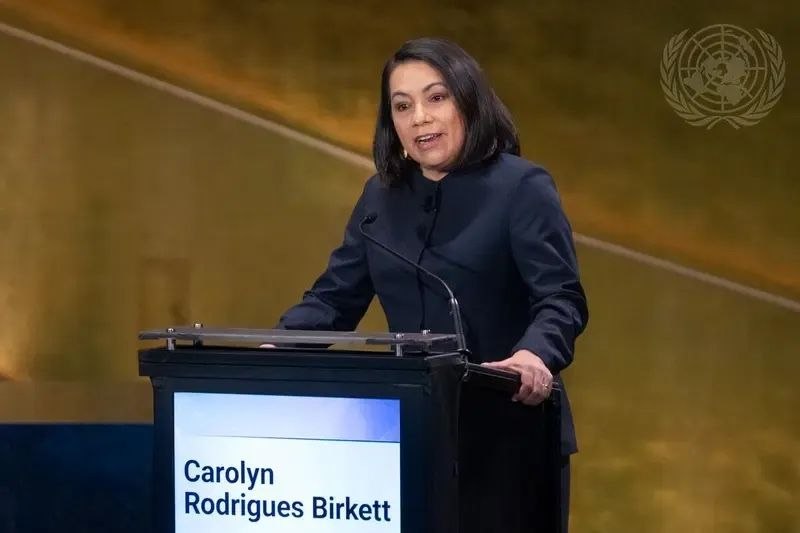
Guyana’s Permanent Representative to the United Nations (UN), Carolyn Rodrigues-Birkett, says the Caribbean is facing a rare opportunity to break new ground at the world body.
Her candidacy for Secretary-General offers the region a chance to secure the organisation’s top post for the first time.
Rodrigues-Birkett described her bid as a “once in an 80-year opportunity” for the Caribbean, pointing to the fact that no national from the region has previously served as UN Secretary-General.
She made the remarks during a recent interview with The Exchange as she outlined her reasons for seeking to lead the 80-year-old international organisation.
“But as it is right now, it’s a once in an 80-year opportunity,” Rodrigues-Birkett said.
She acknowledged that the Secretary-General’s position is widely regarded as one of the most difficult jobs in international diplomacy, particularly at a time when the UN is under intense scrutiny over its ability to respond to global crises.
However, Rodrigues-Birkett said her decision to enter the race was driven by service rather than the prospect of recognition.
She said, “You’re right that some people describe it as the most thankless job in the world, but I’ve never approached service from a position of thanks, always from service.”
Rodrigues-Birkett, who previously served as Guyana’s Foreign Minister, said her own experiences within the UN system have also shaped her decision to seek the position.
She noted that she has worked within the organisation and travelled to several countries where she witnessed UN personnel operating on the ground, often under difficult and dangerous conditions, to assist vulnerable populations.
“I’ve seen people working on the ground, UN staff, committed people, putting themselves at risk to bring help to people,” she said.
The Guyanese diplomat also highlighted the longstanding relationship between the UN and countries such as Guyana, arguing that developing states have benefited significantly from the organisation’s support.
She added, “I’ve worked in the United Nations, but I’ve also seen how the United Nations accompany my country. In fact, it has accompanied many countries.”
Rodrigues-Birkett said this history should not be forgotten amid the criticism currently directed at the organisation.
“We’ve sort of been brought up in the UN, so to speak, and so it will be ungrateful to kick the ladder on which you climb,” she said.
At the same time, she acknowledged that the UN cannot simply rely on its past achievements and must adapt to changing global realities.
Her vision, she said, is for an organisation that “learns from the past, that is fit for today, and that is ready for the future.”
Rodrigues-Birkett said she sees opportunities to strengthen the organisation despite the geopolitical challenges facing it, particularly by improving how the UN delivers for countries on the ground.
“I see opportunities to make the UN better, to make it deliver better, especially on the ground for countries,” she said.
Her candidacy comes at a time when questions about regional representation and the effectiveness of the UN are likely to feature prominently in the Secretary-General selection process.
For Rodrigues-Birkett, the Caribbean’s absence from the organisation’s top leadership post makes the current contest particularly significant.
While acknowledging that another opportunity for the region could eventually emerge, she warned that it may take decades.
The current race, therefore, represents more than an individual bid for the top UN position, she suggested—it is an opportunity for the Caribbean to make history while bringing its perspective and experiences to the centre of global diplomacy.
Rodrigues-Birkett is competing against Costa Rica’s Rebeca Grynspan Mayufis, Secretary-General of UN Trade and Development; Argentina’s Rafael Mariano Grossi, Director-General of the International Atomic Energy Agency; Uganda’s former UN Under-Secretary-General Olara Otunnu; former Senegalese President Macky Sall; former UN General Assembly President and former Ecuadorian Foreign Minister María Fernanda Espinosa Garcés; and Ecuadorian diplomat Ivonne A-Baki.
In the latest UN Security Council straw poll on September 29, Grynspan emerged as the frontrunner with 10 “encourage” votes, while Rodrigues-Birkett and Grossi each secured eight, placing them jointly in second place.
The informal polls are intended to gauge the level of support among the 15 Security Council members before the Council eventually recommends a candidate to the 193-member General Assembly.