
As the new Guyana Development Bank opens with interest-free loans for small businesses, a Georgetown entrepreneur has rebuilt the country’s online front door, so that a business can own its piece of the internet in the time it takes to drink a coffee.
GEORGETOWN, Guyana — On Oct. 5, in a ceremony heavy with the language of national transformation, President Mohamed Irfaan Ali declared open an institution his government had promised for years: a development bank that will lend up to 3 million Guyanese dollars, roughly US$14,000, to small businesses, with no interest and no collateral.

“This is not a grant,” the president told the room. “This is your opportunity to earn, your opportunity to build your credit.”
The Guyana Development Bank arrives in a country that is, by almost any measure, the fastest-growing economy on earth. Oil revenue has lifted gross domestic product by double digits for five straight years. Last year alone, more than 36,000 new business names were registered with the Deeds and Commercial Registries Authority. Cranes crowd the Georgetown skyline. The talk in the capital’s cafés is of contracts, capital and what comes next.
But ask those 36,000 new business owners where their companies live on the internet, and most will give the same answer: a Facebook page, an Instagram handle, a WhatsApp number.
Guyana’s own corner of the web, the .gy domain, has stayed strangely empty. The most recent public count put the entire .gy zone at roughly 3,000 names, a fraction of a single year’s worth of new business registrations. For a nation now flush with ambition and, as of this month, with credit, that gap is becoming hard to ignore.
Keron Bruce noticed it before most, because he lived it.
One Week for a Web Address
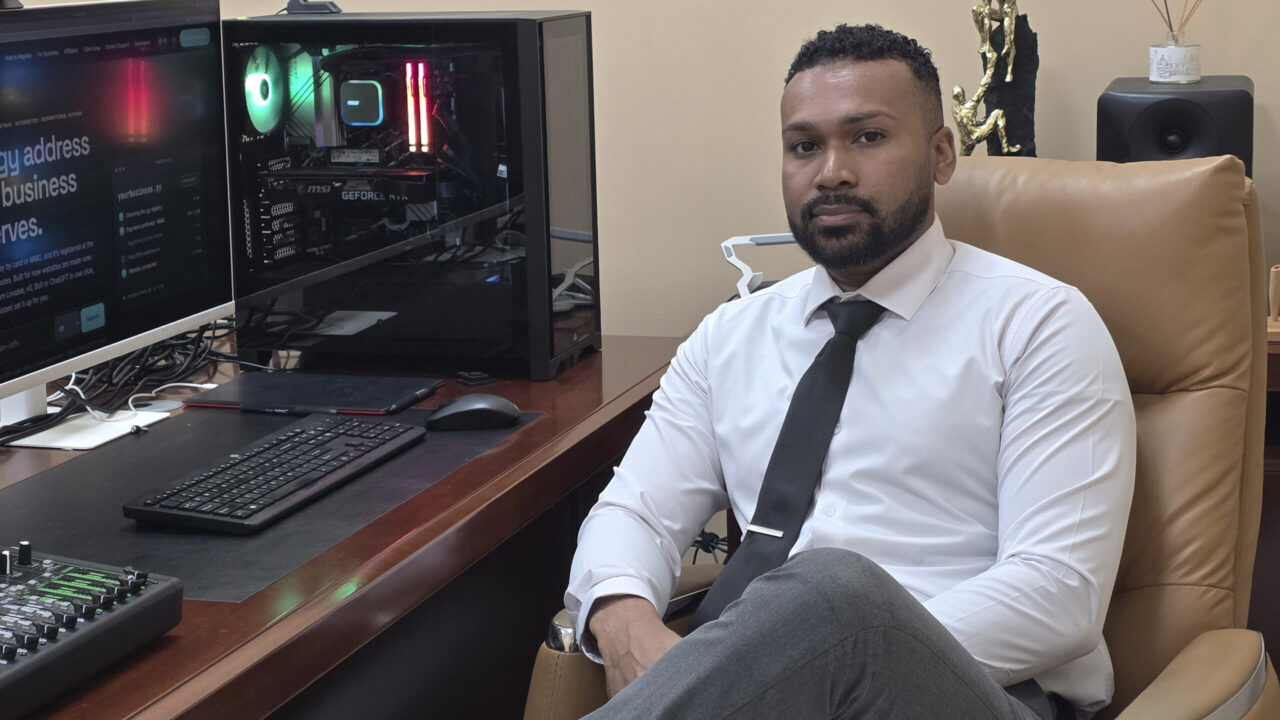
Mr. Bruce is not the person one expects to find at the center of Guyana’s domain-name economy. His company, Investigative Intelligence Solutions Inc., known locally as IIS, is a licensed private investigation and cybersecurity firm based at Soesdyke, on the East Bank of Demerara. It does background checks, digital forensics, penetration testing and polygraph examinations across all ten of the country’s regions. Its motto is “Discreet. Precise. Elite.”
What drew him to domain names was not fascination but a week of frustration.
When IIS needed its own address, iis.gy, Mr. Bruce went to the National Data Management Authority, the government body then associated with the country’s internet infrastructure. He was directed to a cellphone repair shop in Georgetown. He asked whether the name he wanted was available and waited a day for the answer. He was quoted a price and told to pay through MMG, the phone-based Mobile Money Guyana service that most Guyanese use in place of cards, and to supply his nameservers, the technical settings that point a domain at a website. He did not have them to hand, so he paid and promised to send them later. He sent them the next day. Two days after that, someone entered them by hand, and iis.gy came online.
“Start to finish, about a week,” Mr. Bruce said. “For a shop owner who just wants a website, that is a locked door.”
For most of the world, buying a domain name has been an instant, automated transaction since the late 1990s. In Guyana, it remained a manual affair well into this decade. The .gy registry is operated by the University of Guyana, which accredits a small number of companies to sell names on its behalf. The process worked, but it did not scale, and it did not match the speed at which the rest of the economy had begun to move.
So Mr. Bruce did what investigators do: he traced the problem to its source and set about removing it. IIS already built its own software, from its client case portal to an MMG payment gateway plugin and a set of online investigative tools. Mr. Bruce had a development team in India that he was confident could build a registrar as automated as the GoDaddys and Namecheaps of the world. He pursued the venture, and IIS applied for and received accreditation from the University of Guyana as a .gy registrar.
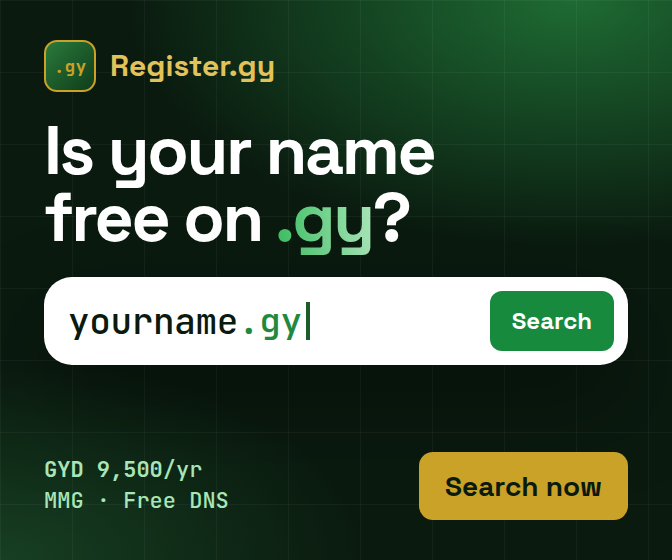
Register.gy went live on April 21, 2026. Its promise is a single sentence: search for a name, pay, and the domain is registered at the registry within minutes, with no human in the loop.
The system talks directly to the registry using the same protocol that powers .com. Payment can be made by card in United States dollars or, crucially for a local market, through MMG in Guyanese dollars. A one-year registration costs 9,500 Guyanese dollars, about US$45, with the same price across .gy, .com.gy, .co.gy, .net.gy and .org.gy. Free DNS hosting, one-click email setup for Google Workspace, Microsoft 365 and Zoho, and support staff in Guyana are included. The registration itself takes minutes. How quickly the website then appears around the world depends on the customer’s hosting company, not the registrar, and Mr. Bruce is careful to say so.
In its first six months the platform has registered close to 100 names, a modest figure that is nonetheless a meaningful share of a zone that counted about 3,000 in total at last public count.
The Furniture Store in Diamond
One of them belongs to Furniture King, a retailer of sofas, beds and mattresses at Great Diamond, on the East Bank Demerara highway. Its site, furnitureking.gy, is the kind of business web presence that was rare in Guyana a decade ago: a catalog, opening hours, and a WhatsApp button for prices. The address tells a customer three things before the page loads. The store is real, it is Guyanese, and it owns its own name.
The Robot Can Do It
The more unusual part of Register.gy is aimed not at people, but at the machines people increasingly use to build things.
Across Guyana, as everywhere, a new kind of entrepreneur is appearing: someone with no coding background who builds a storefront or booking site by describing it to an artificial intelligence tool such as Lovable, Bolt, Replit or ChatGPT. The site itself can be done in an afternoon. Then the builder hits a wall. The AI tools can sell a .com, but almost none of them can sell or configure a .gy name, and connecting one by hand means wading into DNS records, the arcane routing tables of the internet.
Register.gy’s answer is to let the customer’s AI assistant do the work. The platform publishes what engineers call an MCP server, a standard interface that lets AI assistants like Claude, ChatGPT and Cursor act on a user’s behalf. A Guyanese baker can tell her assistant, in plain English, to put her new Lovable site on her .gy domain. The assistant reads the settings from the website builder, shows her the changes it intends to make, waits for her approval, applies them, and checks that the site is live. Every change can be undone for seven days.
Mr. Bruce believes Register.gy is the first .gy registrar to offer this, and among a small number of registrars anywhere to have built it into the core of the product rather than bolted it on.
“The next generation of Guyanese business owners will not learn what a nameserver is, and they should not have to,” he said. “They will talk to their AI the way they talk to a contractor. We built the registrar that the contractor can call.”
The company is careful about how it describes its position. Its site says that Register.gy is officially accredited by the University of Guyana as a .gy registrar through IIS, and notes that any accredited registrar writes names into the same registry with the same rights. It does not claim to be the registry itself, and it publishes a live check that lets anyone confirm its accreditation against the registry’s own public records.
Capital Meets Credibility
What makes this month different is the bank.
The Guyana Development Bank opened with an initial capital injection of 20 billion Guyanese dollars from the 2026 budget, the first tranche of 40 billion in authorized share capital, a figure the government has put at roughly US$100 million. Its mandate is explicitly small: loans of up to 3 million Guyanese dollars for ecotourism operators, farmers, tradespeople, light manufacturers, village shops and service businesses, in all ten regions. Alongside the money, the bank promises mentoring, training and help writing a business plan, with the stated aim of graduating borrowers into the commercial banking system.
“This institution is about helping our citizens participate in the formal financial system,” said Ashni Singh, the finance minister, who signed the order bringing the bank’s act into force.
Susan Rodrigues, the minister of tourism, industry and commerce, urged chambers of commerce and would-be borrowers to have their proposals ready. “The door to financial empowerment is wide open,” she said.
Formality is the operative word. A development bank, by design, wants to lend to businesses that look and behave like real enterprises: registered, reachable, with a plan on paper and a presence that an officer can verify. And in 2026, presence means a web address.
For a borrower, a .gy domain costs less than one percent of the smallest meaningful loan. It gives the business a professional email address instead of a free webmail account, a page that a loan officer, a supplier or a foreign customer can find by name, and a signal to search engines that the company is Guyanese and serves Guyanese customers. It also plants a flag. A .com can be registered by anyone, anywhere. A .gy says where you are from.
Register.gy has had no dealings with the new bank, and Mr. Bruce does not pretend otherwise. His case is simpler.
“If the bank is going to put three million dollars behind your idea, your idea should have an address,” he said. “A .gy name makes a new business look official, and it is cheap to get. For someone walking out of that bank with a loan and a plan, it is the easiest first step there is.”
Register.gy is not the only company that could sell that step. The registry’s own site lists other accredited sellers, and at least one competitor offers a lower headline price. Mr. Bruce argues that the difference lies in what happens after the purchase: free DNS, email in one click, local support by phone and WhatsApp, and a platform that an AI assistant can drive. Whether the market agrees will become clear over the next year, as the first development bank loans are disbursed and a new cohort of businesses decides where to live online.
The Diaspora Dividend
There is a second audience that neither the bank nor the registrar can afford to overlook. Guyana’s diaspora, concentrated in New York, Toronto and London, is larger than many of the country’s regions. Remittances approached half a billion United States dollars last year. Increasingly, those abroad are not just sending money home but starting businesses there: guest houses, farms, import ventures, consultancies built on the oil economy.
The .gy domain has no residency restriction. A Guyanese-American in Queens can register one tonight and pay by card. For that buyer, a short, memorable .gy name is a way of saying, to customers and to family, that the business is anchored at home.
Mr. Bruce has noticed the two-letter names going first. The site advertises them openly, alongside the fact that the zone remains, in its words, wide open.
A Country Catching Up With Itself
The arc of Guyana’s past decade has been one of infrastructure racing to catch up with wealth: roads, bridges, a gas-to-energy plant, a digital identification system, and now a bank. The online address of a small business is a modest piece of that infrastructure. It is also one of the few pieces that a single determined entrepreneur, without a ministry or a budget line, could fix on his own.
Mr. Bruce did not wait for the system that made him wait a week to change. He built a registrar that did the job in minutes, and then opened it to the machines his customers were already using.
“Guyana is going to be built by people who have never built anything before,” he said. “The bank is giving them the money. We are making sure that when they go to claim their name, nobody tells them to come back in a few days.”
As of this week, a search on Register.gy for a name that does not yet exist returns a price, a button and a promise: registered in minutes.