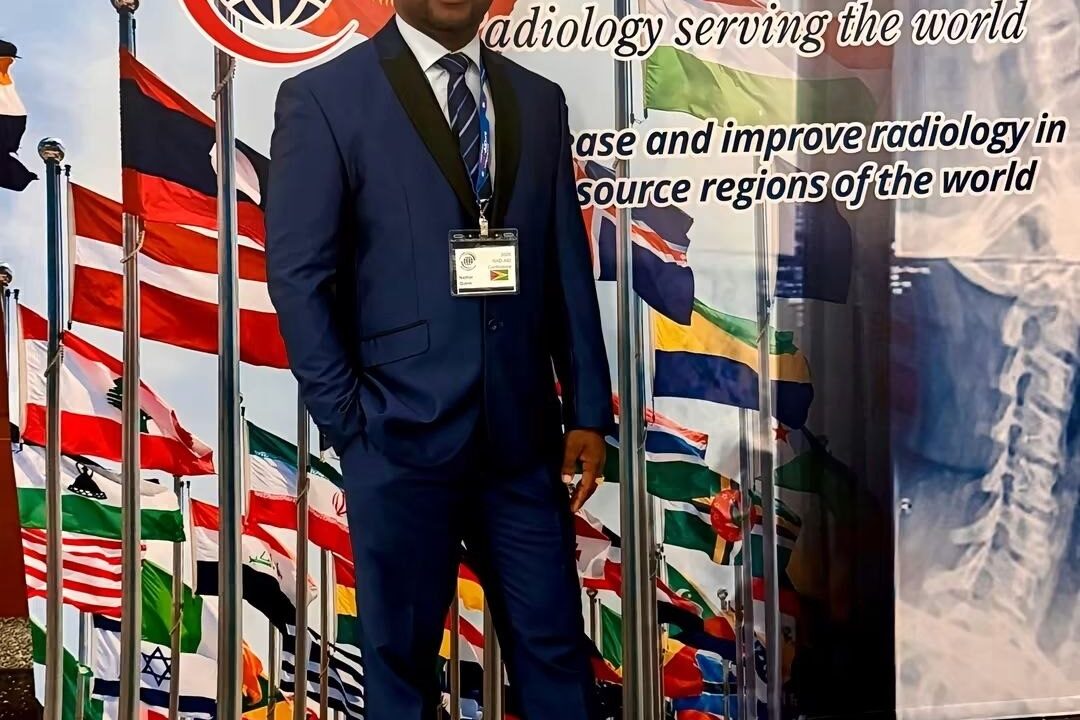

Research into how patients can receive reliable CT scan results while keeping radiation exposure as low as reasonably achievable has taken Georgetown Public Hospital Corporation (GPHC) radiologist Dr Nathel Quinn to an international stage.
Dr Quinn recently presented at the 2026 RAD-AID International Global Health Radiology Conference, sharing findings from his work at GPHC and examining how Guyana can strengthen its diagnostic imaging services.
According to a statement from the hospital, his research assessed radiation doses and image quality in Computed Tomography (CT) scans of the head, chest and abdomen-pelvis. The work addressed a practical concern: obtaining images clear enough to support accurate diagnoses while limiting patients’ exposure to radiation.
The statement highlighted the need for special consideration when imaging children and pregnant patients.
Dr Quinn also pointed out that a CT scan or X-ray is not necessary in every case. Depending on the information needed, ultrasound or Magnetic Resonance Imaging (MRI), which do not use ionising radiation, may be suitable alternatives.
With Guyana expanding its diagnostic services, including the introduction of its first MRI machine at GPHC, he emphasised the importance of carefully selecting examinations and maintaining proper radiation protection.
His original research earned him the Best Research Presentation award from the Institute of Health Science Education (IHSE). GPHC said he regarded the recognition as meaningful and humbling, particularly because the work examined a challenge within the hospital’s own clinical environment.
At the RAD-AID conference, his presentation, titled “Building CT Capacity in Guyana: Identifying Limitations and Solutions,” went beyond the research findings to explore how they could guide improvements in services.
Among the areas examined were quality control, radiation protection, staff training, medical physics support and international collaboration, all aimed at making CT services safer, more reliable and sustainable.
For Dr Quinn, the experience also demonstrated that research conducted in Guyana can contribute to discussions on healthcare beyond the country’s borders.
He hopes it will encourage other local healthcare professionals to investigate challenges in their departments, share their findings and pursue collaboration with international researchers.
His next steps include further work on CT quality assurance, radiation dose monitoring and the development of diagnostic reference levels suited to Guyana and the wider Caribbean.
According to the statement, Dr Quinn explained that imaging standards developed in high-income countries may not always reflect the resources and infrastructure available in developing nations. Locally relevant standards could therefore help institutions make practical improvements while maintaining patient safety.
He is also interested in structured reporting, image quality assessment, evidence-based imaging protocols and the use of artificial intelligence in radiology.
GPHC said Dr Quinn views research as a means of identifying opportunities for improvement and using evidence to guide decisions that lead to better patient care. The challenges encountered in Guyana’s healthcare system, he believes, can also provide valuable lessons and opportunities for innovation.