
Financial analyst Joel Bhagwandin has called for Guyana’s monetary and exchange-rate framework to be strengthened to keep pace with the country’s expanding oil wealth, arguing that the existing tools are becoming increasingly inadequate for the scale of its financial system.
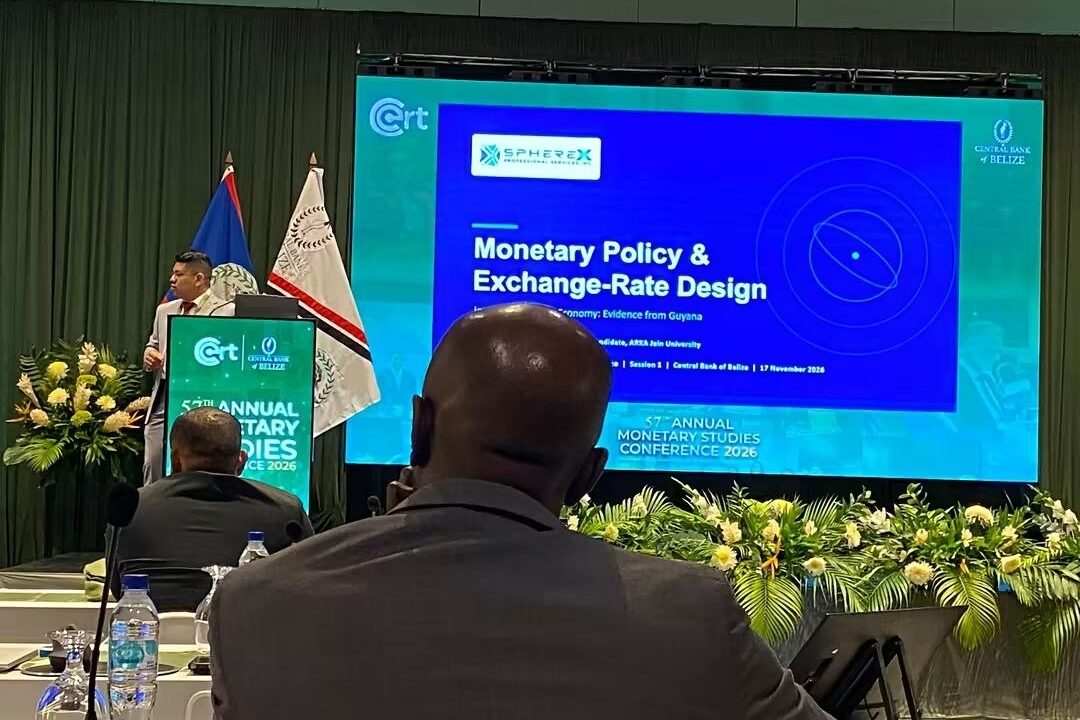
Bhagwandin made the case in a research paper presented at the 57th Annual Monetary Studies Conference in Belize, hosted by the Central Bank of Belize and the Caribbean Economic Research Team (CERT).
According to Bhagwandin, Guyana’s financial system has grown from approximately 90 per cent of non-oil Gross Domestic Product (GDP) before oil production to nearly 200 per cent. However, he contends that this expansion has not been matched by a similar deepening of financial intermediation, the process through which financial institutions channel funds into lending and investment.
He described Guyana as having a multi-trillion-dollar financial system that ranks among the deepest in the region by balance-sheet size, but among the shallowest in terms of financial intermediation.
“Consequentially, I contend that in the abundance era, the current operating framework and monetary toolkit are becoming increasingly inadequate,” Bhagwandin stated.
His paper, titled Monetary Policy and Exchange-Rate Design in an Emerging Oil Economy: Evidence from Guyana, examines how a framework developed for a much smaller economy should adapt as oil revenues, government expenditure, commercial bank balance sheets and the sovereign fund expand.
Bhagwandin was careful, however, to distinguish his call for reform from a warning of immediate economic instability.
“The paper’s conclusion is not that Guyana faces CPI overheating or an imminent exchange-rate crisis. The conclusion is operational,” he explained.
In its October 2026 assessment of Guyana, the International Monetary Fund (IMF) similarly recommended strengthening the country’s monetary framework. However, it found that available indicators did not point to clear economic overheating and assessed the current exchange-rate regime as appropriate, while recommending continued monitoring of wage and competitiveness pressures.
The focus, he said, is on equipping the central bank to manage the demands of a larger financial system while maintaining stability.
Among the areas identified for strengthening are liquidity forecasting, coordination of government payments, monitoring of foreign-exchange settlements and the development of a deeper securities market.
His argument is that liquidity, the transmission of monetary policy, import demand associated with government spending and foreign-exchange settlement must be managed together as the financial resources held by key institutions grow.
“Key message: manage abundance while preserving price, external and financial stability,” Bhagwandin said.
The paper forms part of his ongoing PhD research. He acknowledged that it is an early contribution intended to establish a foundation for further research and policy development.
“This is an early conference paper from a wider PhD research undertaking. It does not purport to settle every question,” he stated.
The conference brought together research from central banks across the Caribbean. Reflecting on his participation, Bhagwandin said Guyana’s economic transformation makes its involvement in regional policy discussions increasingly important.
“Guyana’s transformation is too consequential for us not to participate seriously in the regional and global policy conversations now taking shape.”