
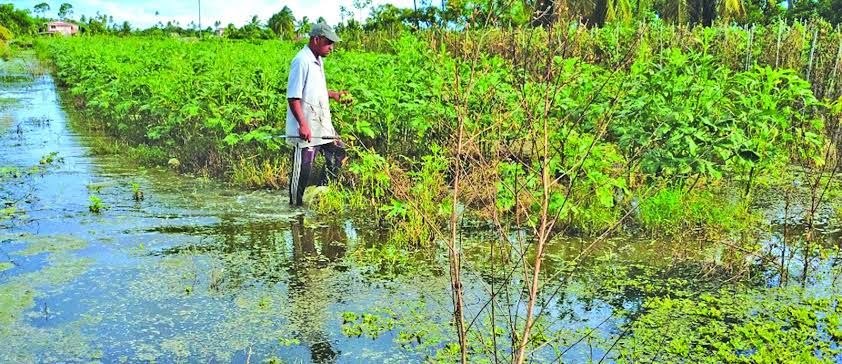
Heavy and prolonged rainfall took a toll on Guyana’s other-crops subsector during the first half of 2026, sending production down by an estimated 6.4 per cent, according to the Ministry of Finance’s Mid-Year Report.
The decline was enough to make the subsector the single largest contributor to the weaker performance of the wider agriculture, forestry and fishing sector, which contracted marginally by 0.5 per cent during the period.
The report said sustained above-normal rainfall disrupted planting cycles, damaged crops and made it difficult for farmers to access fields in producing areas.
The situation worsened during the second quarter, when prolonged rainfall left cultivations waterlogged, reduced yields and damaged crops.
“The other crops subsector, in contrast, is estimated to have contracted by 6.4 percent in the first half of the year, the single largest contributor to the overall sector outturn,” the report stated.
Several categories recorded declines, with cole crops suffering the steepest contraction at 19.1 per cent.
Spice production fell by 17.7 per cent, while beans and cereals declined by 5.7 per cent. Vegetable production was also down by 4.2 per cent.
However, some crops managed to record strong increases despite the difficult weather conditions.
Root-crop production jumped by 27.4 per cent, while fruit production increased by 14.5 per cent. Coconut output also grew by 6.3 per cent during the first half of the year.
El Niño poses another challenge
While farmers recover from the effects of excessive rainfall, the Ministry has warned that another weather challenge could emerge during the remainder of the year.
Anticipated El Niño conditions are expected to bring the risk of heat stress to crops during the second half of 2026.
“Looking ahead, the anticipated onset of El Niño conditions in the second half of the year is expected to subject crops to heat stress just as they recover from flooding in the first half of the year,” the report stated.
Against that backdrop, the full-year growth projection for the other-crops subsector has been revised to just 2.1 per cent.
The report said Government is continuing its national shade house programme and other measures in key agricultural regions to encourage more climate-resilient cultivation and help farmers cope with both excessive rainfall and dry-season conditions.
More broadly, the Ministry said anticipated El Niño conditions pose a downside risk to agricultural production, particularly non-traditional crops, during the second half of the year.13:56