
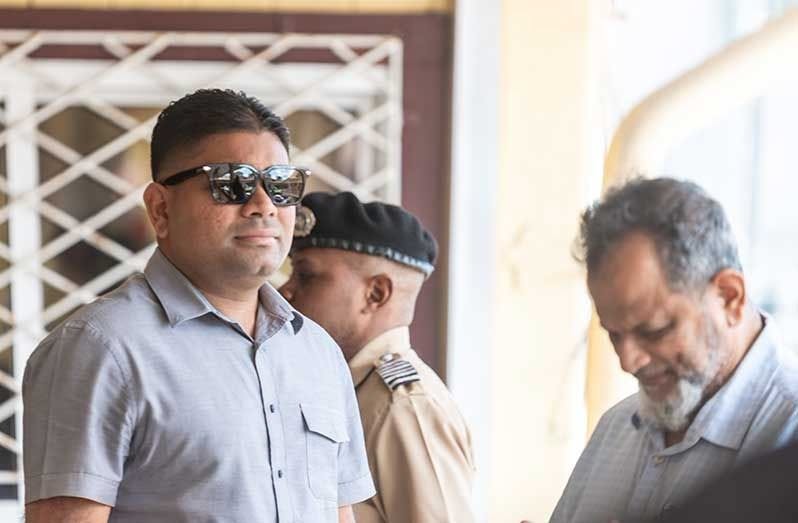

Attorney General and Minister of Legal Affairs Anil Nandlall, SC, says the Caribbean Court of Justice’s ruling in the Nazar and Azruddin Mohamed extradition challenge confirmed that their allegations of bias were rejected at every level of the court system.
The CCJ delivered its ruling last Wednesday in the matter filed by Nazar and Azruddin, who argued that the extradition process was invalid because it was tainted by actual or apparent bias on the part of the Minister of Home Affairs.
Nandlall said all seven judges who heard the matter at the CCJ rejected the submissions advanced by the Mohameds and upheld the submissions made on behalf of the Attorney General and the Minister of Home Affairs.
“All came to the same conclusion that the ATP was valid and there was no finding of bias required by the law to invalidate the ATP,” he said.
The Attorney General said the CCJ delivered three separate judgments, but all arrived at the same conclusion, that the bias claim had not been made out and the appeal should be dismissed.
He said the matter had now been considered by a total of 11 judges, including the Chief Justice in the High Court, three judges of the Court of Appeal and seven judges of the CCJ.
“So you have a total of 11 judges who heard this case and rejected at every stage the arguments advanced by the Mohameds,” Nandlall said.
The Attorney General noted that the appeal was dismissed and the interim stay previously granted against the Magistrate’s Court proceedings was lifted, clearing the way for the committal proceedings to resume.
Nandlall also responded to public commentary that the CCJ had “clarified” the law, saying he did not believe there had been uncertainty in the first place.
“It was a simple case of bias, and we said from the beginning that bias in accordance with established legal principles cannot be established in this case. And every judge who heard the matter so ruled,” he said.
He acknowledged that the CCJ made observations about public statements by government officials, including himself, but maintained that any bias attributed to him did not have the legal effect required to invalidate the extradition process.
“My contention always was that my bias doesn’t have the legal impact required to invalidate any process,” Nandlall said.
He said his role was limited to advising the Minister of Home Affairs on basic legal principles and argued that the Attorney General has a duty to defend the legal system when it is attacked in the public domain.
Nandlall also pointed to sections of the CCJ ruling which, according to him, addressed the conduct of the appellants and their public criticisms of the Government and the local justice system.
He said the Mohameds had alleged that the extradition proceedings were politically inspired and that Guyana’s courts were being politically influenced.
“In fact, the second named appellant put a post up that he was ill with dengue and had to cross the Caribbean Sea to get justice. Well, he got justice,” Nandlall said.
“I hope he’s satisfied with the justice that he got,” he added, while urging the public to read the full judgment and not rely on selected extracts being circulated on social media.
The CCJ ruling now allows the extradition proceedings against the Mohameds to continue before the Magistrate’s Court.