

President Dr Mohamed Irfaan Ali has called on Caribbean countries to independently assess the cost of decarbonising global shipping, warning that relying on external assessments could lead to policies that hinder regional growth.
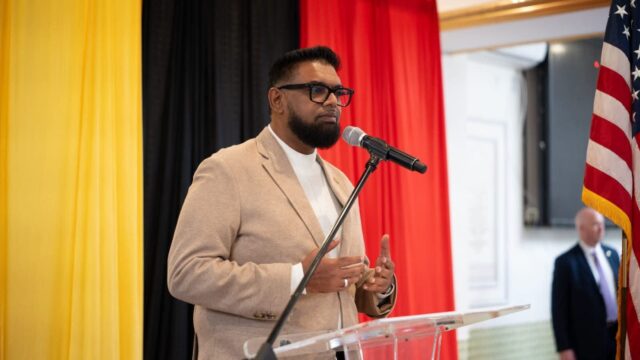
President Ali made the call on Monday during his keynote address at the opening of the Caribbean Shipping Association’s (CSA) 56th Annual General Meeting Conference and Exhibition at the Marriott Hotel in Kingston, Georgetown.
“This net zero conversation must not just be a sexy conversation for a room. It must be a practical conversation,” President Ali said.
“Guyana speaks on the issue with authority,” He affirmed. “We know about net zero because we are one of the greatest contributors to net zero in the world.”
The President noted that the global shipping industry will require an estimated US$2 trillion by 2050, not to build new vessels, but strictly to land, store and deliver clean fuel.
Questioning how these costs will be distributed, President Ali cautioned that the Caribbean could end up bearing a disproportionate share of the financial burden.
Citing figures from the United Nations Conference on Trade and Development (UNCTAD), he said decarbonising vessels will require between US$8 billion and US$28 billion each year up to 2050. Full decarbonisation, he added, could initially raise annual marine fuel spending by 70 to 100 per cent.
“No one is taking that cost as a social good. That cost has to be passed on to someone,” he said.
Clarifying his stance, President Ali underscored that his reservations pertain not to the ultimate goal of decarbonisation, but to the necessity of the region thoroughly evaluating the operational and financial impact on its maritime sector.
He pointed to uncertainty over which fuel will power the transition, with options including biofuel, green methanol, green ammonia, hydrogen, battery electricity and LNG.
Shipowners will not spend billions retooling their vessels without knowing where future fuel supply will come from or what it will cost.
Dr Ali called on the industry to use forums such as the CSA conference to produce honest, independent analysis, so the region can support policy decisions that are not harmful to the planet or to business.
The four-day conference is themed “Building a More Connected, Resilient, and Competitive Caribbean.” It runs until October 28.