
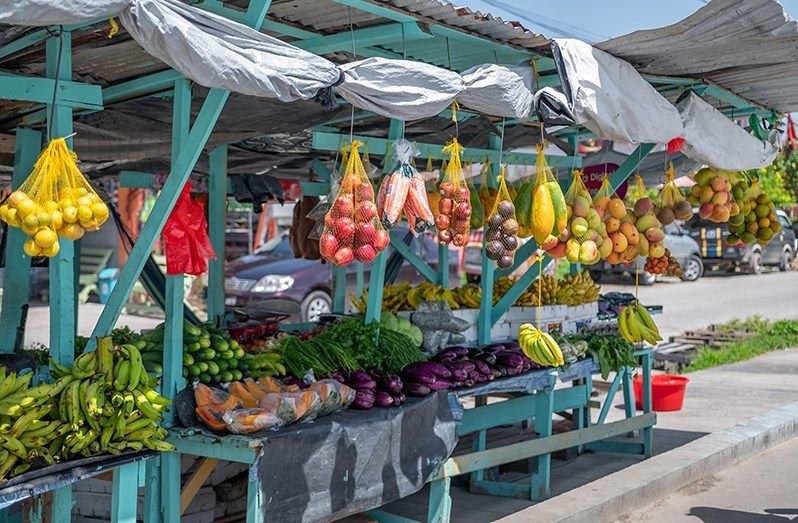

President Dr. Irfaan Ali says the government may have to examine the creation of permanent farmers’ markets across Guyana as part of a wider effort to tackle cost-of-living pressures and reduce the gap between farm-gate and retail prices.
Speaking during a press conference on Tuesday, Ali said cost-of-living challenges must be addressed from several angles, including global price shocks, input costs, retail markups and changing consumer habits.
The President said Guyana is affected by imported inflation because, although the country produces crude oil, it still imports refined fuel and other products. He said global disruptions have also affected the cost of fertiliser, agrochemicals and pharmaceuticals, which in turn pushes up food prices.
The Head of State said the government has already used several policy tools to help reduce production costs, including removing VAT and other taxes, providing subsidies to farmers and reversing increases in drainage and irrigation charges and land rental fees.
However, he said the country must now look more closely at what happens between farmers and retailers.
According to Ali, farmers have complained that produce sold at one price in the wholesale market is being resold at much higher prices by the time it reaches consumers.
“So the farmers, when you go to the wholesale market, the farmers are saying, look, we’re selling plantains at X dollar. But when it gets to the market, it’s 10X,” Ali said.
He said one possible response is the establishment of farmers markets as a permanent part of the country’s buying system, giving farmers more direct access to consumers.
“We may need to look at the creation of farmers markets across the country as a permanent part of our buying ecosystem so that farmers have direct access to the market,” he said.
Ali also pointed to changing shopping and eating patterns as part of the cost-of-living issue. He said more Guyanese are now shopping in supermarkets, where margins are different from traditional markets, and more families are eating out or cooking less at home than they did four years ago.
The President said those shifts have added a cultural dimension to the challenge, since some items that were once commonly bought in open markets are now being purchased in supermarkets, where operating costs and profit margins may be higher.
He also highlighted bottled water as another everyday cost affecting families, noting that children, workers and pensioners often buy water throughout the day. The President said water is an essential commodity that may have to be addressed differently, even though government’s role is generally to enable private-sector growth rather than compete with businesses.
Ali said grants alone will not solve the cost-of-living problem, although they remain useful in supporting vulnerable groups and boosting household income.
“No amount of grant will address it,” he said, adding that the issue must be handled structurally by examining the movement of goods from farmers to retailers, the input costs faced by producers and the margins being added along the way.
The President said the government will have to approach the matter in a “multi-dimensional” way, taking into account cultural changes, buying patterns, eating habits, retail margins and global pressures.
“It has to be holistic,” the President said.