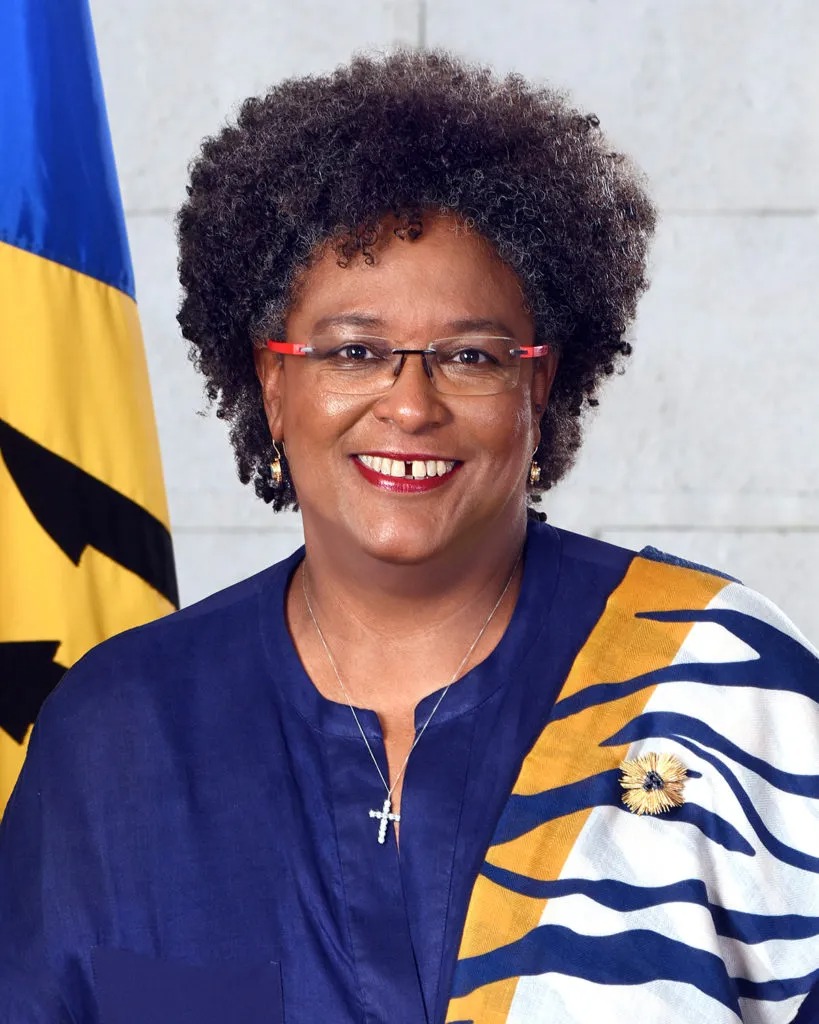

Barbados’ Prime Minister Mia Mottley has issued a renewed and impassioned call for Caribbean Community (CARICOM) member states to adopt the Caribbean Court of Justice (CCJ) as their final appellate court, saying that full regional integration and legal autonomy cannot be achieved without embracing the CCJ.
Speaking at the opening of the 49th CARICOM Heads of Government Meeting in Montego Bay, Jamaica, on Monday, Mottley described the CCJ as essential to the region’s democratic stability and jurisprudential independence.
She appealed directly to both governments and citizens across CARICOM to show “singular purpose” in supporting the regional court.
“We have a duty to our citizens,” Mottley declared. “It would be remiss of me not to salute Winston Anderson, the new President of the Caribbean Court of Justice… and you will forgive me if I now make yet another appeal to the citizens of this region to allow their governments to know that there ought to be a singular purpose for the Caribbean Court of Justice to be truly the last Court of Appeal for the states of this region.”
Only a handful of CARICOM states currently recognise the CCJ in its appellate jurisdiction, with others still relying on the United Kingdom-based Privy Council.
Mottley urged regional leaders to begin or resume public education campaigns to overcome constitutional hurdles, including referenda, in certain states.
“This, like everything else, ought to be the subject of public education,” she said.
“And if we can so do, then I believe we can finally start to move the needle generationally for us, recognising that this ought to be our final court.”
The veteran regionalist stressed that small island states must control their own jurisprudence, particularly when addressing sensitive security and human rights matters.
“Our small vulnerable states… are also to be taken into account with respect to our Caribbean jurisprudence,” she said, citing the importance of responsive, localised legal systems that reflect the realities of Caribbean societies.
The CCJ was inaugurated in Port of Spain, Republic of Trinidad and Tobago, on April 16, 2025 and presently has a Bench of six judges presided over by CCJ President, Justice Winston Anderson.
The CCJ has both Original and Appellate Jurisdiction, and is, effectively, therefore, two courts in one.
In its Original Jurisdiction, it is an international court with exclusive jurisdiction to interpret and apply the rules set out in the Revised Treaty of Chaguaramas (RTC) and to decide disputes arising under it.
The RTC established the Caribbean Community (CARICOM) and the CARICOM Single Market and Economy (CSME).
In its Original Jurisdiction, the CCJ is critical to the CSME, and all 12 Member States which belong to the CSME (including their citizens, businesses, and governments) can access the Court’s Original Jurisdiction to protect their rights under the RTC.
In its Appellate Jurisdiction, the CCJ is the final court of appeal for criminal and civil matters in those Caribbean countries that have amended their national Constitutions to enable the CCJ to perform that role.
At present, five states access the Court in its Appellate Jurisdiction, these being Barbados, Belize, Dominica, Guyana, and Saint Lucia.
However, by signing and ratifying the Agreement Establishing the CCJ, Member States of the Caribbean Community have demonstrated a commitment to making the CCJ their final court of appeal.