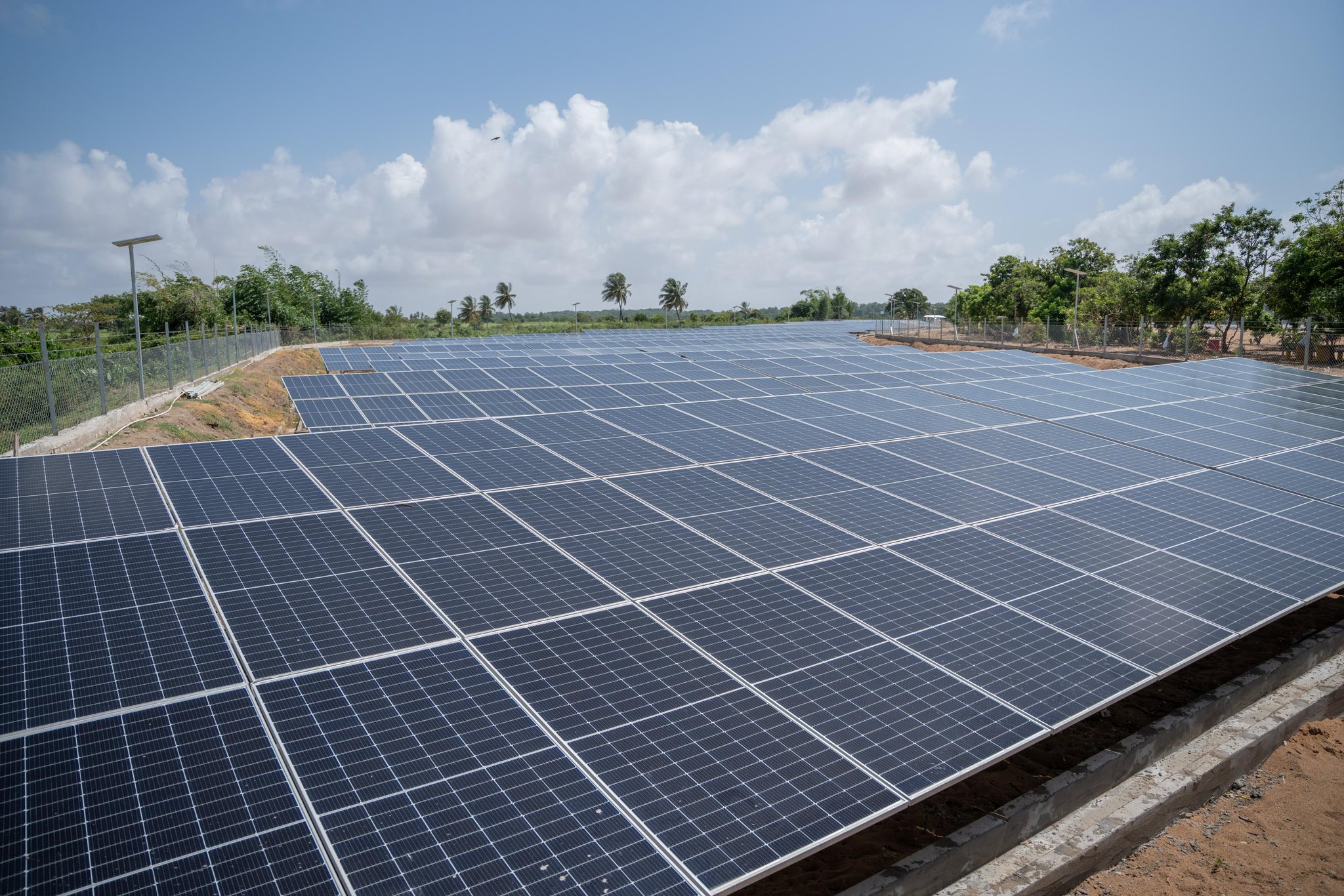
Head of the Guyana Energy Agency, Mahendra Sharma, says the government’s newly launched grid-connected solar household initiative could significantly reduce monthly electricity costs for consumers, while creating a new class of energy producers across the country.Speaking on the Starting Point podcast hosted by Kiana Wilburg, Sharma detailed how the Low Carbon Development Strategy (LCDS) Grid Connected Solar project is designed to ease reliance on the national grid while putting money back into consumers’ pockets.Sharma explained that the system prioritises solar energy use within the home before drawing from the grid.“A grid-connected solar system is simply solar panels that you install on your roof… and that is connected to the mains of your building,” he said.As sunlight is converted into electricity throughout the day, that energy is used immediately within the household.“So if your refrigerator is on, your TV is on… it displaces that energy immediately with whatever comes from the sun,” Sharma noted.Only when solar generation falls short does the system automatically pull additional power from the Guyana Power and Light (GPL), eliminating the need for manual switching.In cases where solar production exceeds household consumption, excess energy is sent back to the grid, enabled by upgraded bidirectional meters.“The excess then goes to the utility… the bidirectional meter counts energy flows from the grid and energy flows to the grid,” Sharma explained.Consumers are credited at 90% of the retail tariff rate, currently about $43.43 per unit, creating a “credit bank” system that offsets future usage.“At the end of the month… they discount what you gave from what you took,” he said.Notably, Sharma revealed that if a household generates more energy than it consumes over a year, GPL is required to pay the customer.“If by the end of the year you end up in a net positive situation… GPL will cut the check and give it to you,” he stated.Using a typical example, Sharma said a 5-kilowatt system, now the standard size on the market, costs about $1.2 million to install.However, it can generate approximately $28,000 worth of electricity monthly.“So it offsets that amount of energy that you use,” he said, pointing out that a household with a $30,000 bill could see most of that cost eliminated.Despite the upfront investment, Sharma noted that households often still consume slightly more than they generate due to increasing appliance use.“The more disposable income we have, the more our consumptive patterns change… so more than often, you end up netting out or you’re always paying a little bit more,” he explained.Still, he emphasised that the system reduces overall consumption while improving energy reliability.Acknowledging the high initial cost, Sharma said the agency has already engaged financial institutions to make the systems more accessible.“Every bank is on board with this initiative,” he said, adding that loan repayments could range from about $7,000 to $26,000 per month depending on financing terms.He noted that persons with existing mortgages may find it easier to access funding.While 5-kilowatt systems are being used as a baseline, Sharma encouraged businesses to consider larger installations.“A 10-kilowatt system is a good idea because the sun cycle… follows perfectly the business cycle,” he said.He added that such systems could also support the growing push towards electric vehicles, allowing businesses to offset both operational and transport energy costs.The initiative is aiming to onboard at least 5,000 households in its first phase. However, Sharma warned that technical limits within the grid could restrict uptake in certain areas.“If you live in a particular area and there is more solar… than the transformers can reasonably handle, GPL will have to set a limit,” he said.Because solar energy is intermittent, too much generation in one area could strain the system.“So the point… is first come, first serve,” Sharma urged.On timelines, Sharma said the process from expressing interest to installation could take between two to three months, depending on demand.The agency will guide applicants through the process, from assessing roof space to selecting installers and securing financing.“We’re going to hold your hands throughout the entire process,” he assured.Consumers will also be able to monitor their systems in real time through mobile apps, tracking energy generation, grid usage, and savings.With over 300 existing “prosumers” already feeding more than 11 megawatts of solar power into the grid, Sharma said the programme is not experimental but proven, and now poised for rapid expansion.“This is tried, tested, and established,” he said.
5,000 homes targeted as GEA rolls out grid solar push, promising major cuts to electricity bills