
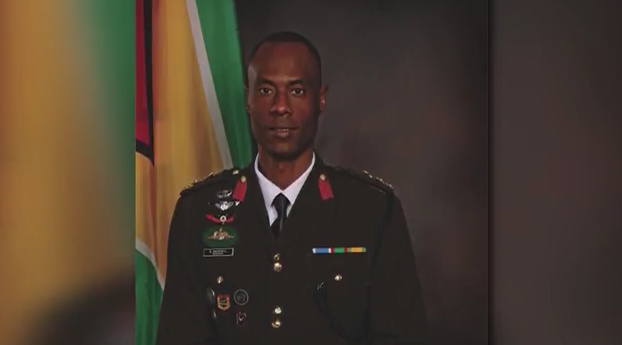
Guyana’s national security architecture is evolving into a modern, data-driven system designed not only to protect borders and resources but also to safeguard citizens in every corner of the country.
This is according to Colonel Sheldon Howell, Director of the National Intelligence and Security Agency (NISA), who appeared on Episode 4 of Safeguarding Our Nation to explain how national security is everyone’s business.
“National security protects our people, our land, and our way of life,” Howell stated.
He explained that the national security system unites all branches of government, incorporating key agencies such as NISA, the Guyana Defence Force (GDF), the Customs Anti-Narcotic Unit (CANU), the Guyana Fire Service (GFS), the Guyana Revenue Authority (GRA), the Special Organised Crime Unit (SOCU), the Guyana Prison Service (GPS), and the Guyana Police Force (GPF).
At the centre of this framework, Howell emphasised, are the people of Guyana.
“At the heart of this architecture is you, the citizens,” he emphasised.
Guyana’s national security strategy, Howell explained, now integrates advanced surveillance and response tools.
These include drones, artificial intelligence (AI), satellite imagery, CCTV systems, and GPS-enabled patrols, all coordinated to respond to threats across land, air, sea, and cyberspace.
“It uses modern tools like drones, sophisticated cameras, satellite imagery, AI, and other data platforms that are coordinated in such a way that they respond quickly to threats,” he said.
“NISA collects the data, processes it, and disseminates it to local and international partners — including the USA, UK, Brazil, France, and countries in the Caribbean and Latin America.”
One successful operation involved shutting down illegal airstrips and mining camps deep in Region Nine.
“Drones spotted illegal airstrips and mining camps. We were able to deploy teams quickly to shut down those operations, thanks to community information as well as aerial surveillance.”
Another case involved the interception of Venezuelan vessels that had crossed illegally into Guyana’s waters.
“We have radar systems and coastal surveillance, along with GPS tap patrol, that let us intercept these vessels to protect our territory.”
In urban centres, the government has implemented CCTV cameras and e-ticketing systems to help reduce traffic violations and assist police with investigations.
In remote areas, cross-border tracking systems are used to monitor the movement of individuals, allowing authorities to detect and understand potential threats more effectively.
“But at the heart of it is the command centre, which connects the dots and helps us to respond quickly,” Howell explained. “You may not see the work all the time, but work is being done behind the scenes to keep our people and our country safe.”
Howell noted that the government is not just focused on acquiring equipment but also on building human capital. The recently launched National Defence Institute (NDI) is one example.
“The Institute seeks to bring together military personnel, academia, the private sector, civil society, and Caribbean nations with the aim to understand common threats and assist in formulating new policies and strategies.”
With growing surveillance capabilities, Howell acknowledged the public’s concerns about privacy and emphasised the government’s commitment to responsible use of technology.
“This is a valid concern, even for me. We take this very seriously. We don’t want to take away people’s freedom; we want to protect it,” he said. “Yes, we use sophisticated technology, but we stick rigidly to the laws that govern us.”
He assured the public that every piece of surveillance equipment is logged and audited, with strict access control and traceability systems in place. Plans are also underway to introduce an oversight board that includes civil society representatives.
“These tools are not a threat once they are used with discipline and with the purpose to earn the public’s trust.”
Howell revealed that the country has strengthened its response mechanisms for missing persons, particularly children. Soon, Guyana will launch a national alert system.
“This system will send real-time information to phones, televisions, radios, and social media platforms,” he said.