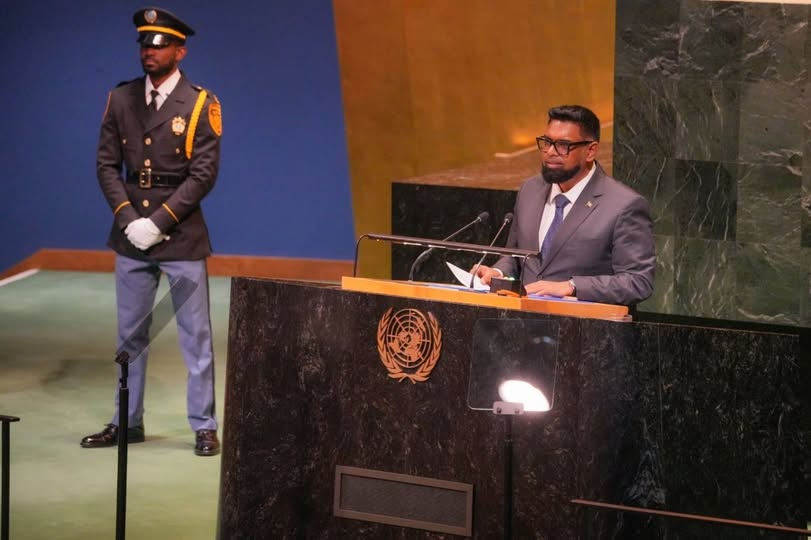

President Dr. Irfaan Ali says Guyana used the 80th Session of the United Nations General Assembly (UNGA) to advance concrete work on climate justice, biodiversity financing and energy security, underscoring that the country is now “a leader, not a listener” in global climate fora.
In an early-morning conversation on Main Street in Georgetown with journalist Kiana Wilburg, the Head of State described the UNGA as “the largest gathering of every stakeholder in global affairs,” noting that the real value often lies in high-level bilateral meetings and technical roundtables held on the sidelines.
“There are a number of meetings that we are engaged in when we go to the United Nations that are critical for development, that are critical for the region, and that are important in the way we define our foreign policy,” President Ali said.
Dr. Ali said Guyana has “cemented” its role as a global standard-bearer on forests and biodiversity. He recalled announcing in 2024 that Guyana would convene a Global Biodiversity Alliance and said that the coalition is now formed, positioning the country to help shape policy and markets.
The President pointed to engagements with Brazilian President Luiz Inácio Lula da Silva on the “Forest Forever Fund,” and to discussions with academic institutions, multilateral agencies and philanthropic platforms. He also cited outreach to Middle Eastern partners, including Saudi Arabia, the UAE and Qatar, who are “setting up a market-based mechanism, a payment mechanism for biodiversity services.”
“On forests, climate change, biodiversity, we are not a listener… we are a leader, and the world recognises Guyana as the foremost leader in this sphere,” he said, adding that biodiversity services form part of Guyana’s economic diversification strategy.
Calling climate justice a “major concept” that is resonating across developing regions, Dr. Ali stressed that fair access to financing for adaptation and mitigation is central to the debate.
He pointed to Guyana’s recurring investments in sea defence, drainage and irrigation along the low-lying coast as examples of costs borne by vulnerable states.
Beyond infrastructure, he highlighted the human impacts, livelihood losses, and population displacement caused by floods and droughts across Asia and Africa, and urged multilateral systems to respond to the full spectrum of climate-driven shocks.
“Climate justice involves the adaptation and mitigation measures and financing for those measures… the fairness of the costs of that financing when countries have to adjust, when countries have to invest,” he noted.
Linking climate policy with development realities, the President argued for a pragmatic energy transition that recognises surging demand from digitisation and artificial intelligence, as well as persistent energy poverty in parts of the developing world.
He said that baseload power will remain essential for years, meaning that petroleum and natural gas will continue to play a role, even as countries expand their use of renewables.
The policy challenge, he added, is to “incentivise research, innovation and technology” that reduce emissions and environmental impacts from energy systems.
“Long into the future, the energy mix will require petroleum and natural gas,” Dr. Ali said. “What the world needs… is balance. The United Nations and institutions of a multilateral nature must lead the discourse to bring positions into the centre.”